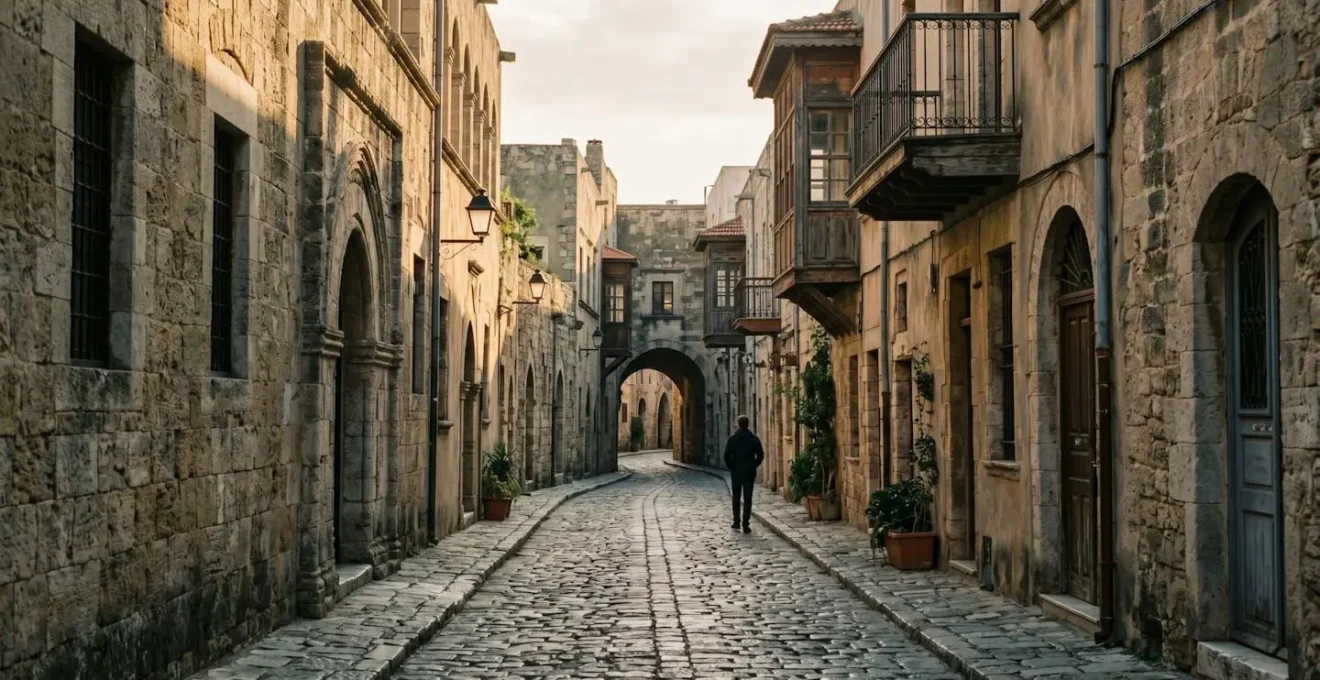
Contrary to popular belief, authentic travel isn’t about finding secret, non-touristy spots; it’s about learning a new method to see the hidden historical layers in the places everyone visits.
- Ancient infrastructure like Roman roads still dictates the layout and rhythm of modern cities, offering a map to the past.
- Focusing on spaces of ancient daily life (markets, apartments) reveals more about a culture than monumental landmarks alone.
Recommendation: Shift your mindset from a tourist’s checklist of sights to a historian’s investigation of the urban environment.
For the thoughtful traveller, there’s a growing sense of disillusionment with modern tourism. You follow the guidebook to Rome, Athens, or Istanbul, stand before the magnificent ruins, and find yourself in a sea of selfie sticks, feeling strangely disconnected from the profound history you came to find. The common advice—travel in the off-season, eat off the main square—only scratches the surface of this problem. You might avoid the worst of the crowds, but you’re still just a spectator, observing the past from a safe, curated distance.
This approach frames travel as a hunt for pristine, « authentic » locations untouched by tourism, a quest that is increasingly futile. But what if the problem isn’t the presence of other tourists? What if the key isn’t finding different places to go, but developing a different way to see? The true history of an ancient city is not just in its colossal monuments; it’s an urban palimpsest, where millennia of life are written, erased, and re-written, leaving faint traces for those who know how to look.
This guide rejects the superficial search for « hidden gems. » Instead, it offers a method for becoming an urban archaeologist of the everyday. We will explore how to read the « infrastructural ghosts » of Roman roads beneath your feet, why the ruins of a fast-food counter can tell you more than a temple, and how to engage with a city not as a consumer of experiences, but as an active interpreter of its layered story. You will learn to see beyond the tourist facade and connect with the deep, living history of these incredible places.
To help you navigate this deeper approach to travel, this article is structured to build your skills as an urban historical explorer. Discover the key debates, practical methods, and critical mindset shifts required to transform your next trip.
Summary: Decoding Ancient Cities for the Modern Traveller
- Why Is Istanbul a Better Ancient City Experience Than Athens for First-Time Visitors?
- How to Walk Ancient Roman Roads Through Modern Cities for Immersive History?
- Guided Tours vs Independent Research: Which Reveals Ancient Cities Better?
- The Tourist Mistake of Seeing Colosseums but Missing Ancient Daily Life Spaces
- When Should You Visit Mediterranean Ancient Cities Without Crowds or Heatwaves?
- Why Do Berlin’s « Alternative » Neighbourhoods Feel Like Tourist Attractions Now?
- Why Do All-Inclusive Holidays Leave Locals Poorer Despite Tourist Presence?
- How Can You Live Like a Local in Major Cities Beyond Tourist Zones?
Why Is Istanbul a Better Ancient City Experience Than Athens for First-Time Visitors?
When considering a first deep dive into an ancient city, the choice often defaults to Athens or Rome. However, a strong case can be made for Istanbul as the superior starting point for learning to read an urban palimpsest. While Athens offers a profound, concentrated vision of the classical world, Istanbul presents an unparalleled, continuous layering of great civilisations—Roman, Byzantine, and Ottoman—that remain visibly and functionally integrated into the fabric of a living, breathing metropolis. Its status as a global hub is undeniable, with projections showing it attracting nearly 18.6 million international tourists in 2024.
The magic of Istanbul for a historical traveller is this very density. You don’t just visit a ruin; you walk through successive ages in a single afternoon. You can stand in the Byzantine grandeur of the Hagia Sophia, descend into the Roman-era Basilica Cistern, and then emerge to witness the Ottoman magnificence of the Blue Mosque, all within a few hundred metres. This isn’t a segregated archaeological park; it’s a city where empires are stacked on top of each other, and modern life flows through their veins. This layering makes the concept of historical continuity tangible in a way few other cities can match.
Unlike the more defined « archaeological zone » feel of central Athens, Istanbul’s history is messier, more chaotic, and ultimately, more alive. The call to prayer from a 17th-century mosque echoes over streets laid by Constantine, while the scent of spices from the Ottoman-era market mingles with the exhaust of a modern tram. For the traveller looking to move beyond simple sightseeing, this city offers the perfect training ground. It forces you to see history not as a static exhibit, but as a dynamic, ongoing process that shapes every aspect of the present.
How to Walk Ancient Roman Roads Through Modern Cities for Immersive History?
One of the most profound ways to connect with the ancient world is to physically walk its paths. Many of Europe’s greatest cities are built upon a Roman skeleton, and these « infrastructural ghosts » continue to shape urban life. The key is to stop looking for ruins and start looking for routes. Ancient roads were not built for scenery; they were arteries of commerce, military movement, and administration, connecting key points with ruthless efficiency. That logic is so powerful that modern streets often follow their exact trajectory, forced into place by the invisible memory of the original infrastructure.
A prime example can be found in London. The financial heart of the modern metropolis sits directly atop Roman Londinium, and its street patterns are a direct legacy. The case study of London’s Modern Streets Following 2,000-Year-Old Roman Roads is illuminating. Today’s Cheapside, a major commercial street, follows the precise path paved by Romans in 47 AD, while Bishopsgate traces the ancient route north to York. As analysis shows, today’s commuters and delivery vans unknowingly follow the same desire lines carved out by Roman soldiers and merchants nearly two millennia ago. This demonstrates that the most enduring monument the Romans left was not a temple, but the sheer logic of their infrastructure.
To experience this yourself, you must shift your focus. Instead of navigating by modern landmarks, use a map of the ancient Roman city as your guide. Trace the path from a former city gate towards the forum. You will likely find yourself on a major modern thoroughfare. Pay attention to the subtle curves and direct lines that feel out of place in a medieval or modern grid. These are often the tell-tale signs of an infrastructural ghost, a path of least resistance determined centuries ago.
This act of walking becomes a form of time travel. The texture of the experience changes. You are no longer a tourist floating on the surface of the present; you are following a deep current, feeling the city’s structure from the inside out. You begin to understand the city’s strategic layout, its commercial heart, and the logic that has governed its growth for centuries. This is the essence of deep travel: using the physical environment to access an intellectual and sensory understanding of the past.
Guided Tours vs Independent Research: Which Reveals Ancient Cities Better?
The debate between joining a guided tour or exploring independently is a classic traveller’s dilemma. The independent explorer prizes freedom and serendipity, while the tour-goer seeks efficiency and expert knowledge. For the traveller aiming for deep cultural immersion, however, the answer is not one or the other. The true determinant of a profound experience is the quality of the narrative being uncovered, whether self-directed or expert-led. A poorly researched independent walk can be as superficial as a large, impersonal bus tour.
The failure of many tours lies in their format: a passive « show-and-tell » where a guide recites facts at a group of disengaged tourists. They focus on the monumental, tick off the checklist sights, and rarely connect the history to the living city. However, a specialised, small-group tour led by a genuine expert—a historian, an archaeologist, a preservationist—can be transformative. These guides don’t just point at stones; they weave a story, connect the site to the broader culture, and teach you *how* to see. Crucially, as research published in the Journal of Heritage Tourism found that successful tours require active participation and a connection to local culture for visitor satisfaction.
Conversely, independent research holds immense potential, but it requires significant front-loaded effort. It’s not just about downloading an offline map and marking points of interest. It’s about reading academic papers, historical accounts, and specialised blogs to build your own narrative *before* you arrive. The goal is to curate your own private tour, with yourself as the expert guide. This method allows you to follow your own curiosity, linger where you wish, and make personal connections that a pre-packaged tour cannot offer. You might spend an hour examining cart-wheel grooves in a Roman road that a tour would pass in thirty seconds.
Ultimately, the best approach is often a hybrid one. Use independent research to build a strong foundational knowledge of the city. Then, strategically deploy a highly specialised tour to access a place or an expert perspective you couldn’t achieve on your own—like gaining entry to an active archaeological dig or an underground section of the city. The choice is not between a guide and a map, but between passive consumption and active investigation. Whichever method fosters a deeper investigation is the right one.
The Tourist Mistake of Seeing Colosseums but Missing Ancient Daily Life Spaces
The typical tourist itinerary in an ancient city is a highlight reel of monumental architecture. We flock to the Colosseum, the Parthenon, the grand forums—places of imperial power, religious ceremony, and public spectacle. While undeniably impressive, focusing exclusively on these sites creates a skewed and incomplete vision of the past. It’s like trying to understand a modern city by only visiting its parliament building and national stadium. This is the great tourist mistake: we see where the ancients put on their grandest shows, but we completely miss where they actually lived their lives.
A far more intimate and revealing history is found in the spaces of the mundane. The ruins of an ancient fast-food counter (a *thermopolium*), a multi-story apartment block (*insula*), or a public latrine tell a richer story of societal norms, diet, and urban density than another temple column. These were the spaces that structured the daily rhythm of 99% of the population. Seeing the worn marble counter of a Roman bar in Pompeii, you can almost hear the gossip and feel the texture of everyday commerce. These places humanize the past and connect us to the Romans or Greeks not as abstract historical figures, but as people who got hungry, felt crowded, and sought community.
To correct this mistake, you must deliberately seek out the mundane. When visiting an archaeological site like Ostia Antica, Rome’s ancient port, bypass the main temple initially and head straight for the residential quarters or the firefighters’ barracks. Look for the small details: the grooves worn into thresholds by countless passing feet, the traces of painted plaster in a modest apartment, the ruts carved into paving stones by delivery carts. These are the artifacts of daily life, and they provide a powerful counter-narrative to the top-down history of emperors and senators.
Your Action Plan: Uncovering Ancient Daily Life
- Points of Contact: Seek out thermopolia (ancient fast-food counters) and popinae (bars) in sites like Pompeii to understand public social and eating habits.
- Collecte: Prioritise visiting residential neighbourhoods and apartment blocks (insulae) over villas to see how ordinary urbanites lived in dense, multi-story housing.
- Cohérence: Explore ancient market spaces (macellum) and identify the grooves from stall doors in forum walls to visualise the city’s commercial pulse, comparing it to the grand political spaces.
- Mémorabilité/émotion: Walk through side streets looking for evidence of non-elite life: cart wheel grooves, simpler brickwork, and public infrastructure like fountains and latrines that served the masses.
- Plan d’intégration: In your travel plan, consciously allocate as much time to a well-preserved residential or commercial district (like Ostia Antica) as you would to a major monument (like the Colosseum).
When Should You Visit Mediterranean Ancient Cities Without Crowds or Heatwaves?
The most common piece of travel advice is to visit in the « shoulder season » to avoid the crowds and heat of summer. While not wrong, this advice is often too simplistic. For the historical traveller focused on deep exploration of archaeological sites, a more nuanced understanding of the calendar is essential. The goal is not just fewer people, but better conditions for observation and photography, which are often at odds with « pleasant » weather.
Peak summer (July-August) should be considered a non-starter for serious site exploration. The combination of extreme heat (often 30-40°C), crushing crowds, and harsh overhead sunlight makes for a miserable and unproductive experience. The high sun bleaches all texture from stone, washing out inscriptions and architectural details, while heat haze distorts long views. It is no surprise that a spatial and temporal analysis of Mediterranean tourism reveals that overtourism is overwhelmingly concentrated in this period. The popular shoulder seasons of late spring (May-June) and early autumn (September-October) are better, but they have become the « new peak, » with significant crowds and still-high prices.
For the truly dedicated urban archaeologist, the most rewarding time is the « deep winter » season from November to February. The crowds are minimal, allowing for solitary contemplation of major sites. More importantly, the low angle of the winter sun is a photographer’s and observer’s dream. It rakes across stone surfaces, picking out every subtle inscription, carving, and weathered texture in dramatic relief. Standing in the Roman Forum on a crisp January morning, with long shadows defining the architecture and a quiet stillness in the air, is an experience of profound connection that is impossible in July.
The following table breaks down the pros and cons, helping you align your travel dates with your specific goals, moving beyond the simple « avoid summer » mantra to a strategic choice based on light, access, and experience.
| Season | Crowd Level | Temperature | Archaeological Visibility | Best For |
|---|---|---|---|---|
| Deep Winter (Jan-Feb) | Minimal | Cool (8-15°C) | Excellent (low sun angle reveals textures) | Photography, detailed site exploration, solitary experiences |
| Spring Shoulder (March-April) | Moderate | Mild (15-20°C) | Good (comfortable conditions) | Walking tours, balanced weather and crowds |
| Early Summer (May-June) | High | Warm (22-28°C) | Poor (harsh overhead light) | Longer daylight hours, pre-peak season |
| Peak Summer (July-Aug) | Extreme | Hot (30-40°C) | Very Poor (washed out details, heat haze) | Avoid for ancient sites; focus on underground spaces |
| Fall Shoulder (Sept-Oct) | Moderate-High | Pleasant (20-25°C) | Good (improving light) | Most popular shoulder season, still crowded |
| Late Fall (Nov-early Dec) | Low | Mild-Cool (12-18°C) | Very Good (lower sun, dramatic shadows) | Off-season pricing, authentic local atmosphere |
Why Do Berlin’s « Alternative » Neighbourhoods Feel Like Tourist Attractions Now?
The life cycle of an « alternative » neighbourhood is a predictable, often melancholic, story that plays out in cities worldwide, with Berlin’s famous districts like Kreuzberg or Friedrichshain as prime examples. What begins as a genuine hub of counter-culture, artistic expression, and affordable living eventually becomes a victim of its own success, transforming into a curated, consumable version of itself—a tourist attraction. Understanding this process is key for any traveller seeking genuine cultural immersion, as it reveals the powerful forces that commodify authenticity.
The process, as seen in the Five-Stage Evolution of Urban Alternative Culture to Tourist Commodity, begins with artists and marginalised communities colonising neglected, low-rent urban spaces. They create a vibrant, authentic local scene. This attracts early-adopter travellers and media attention. Soon, guidebooks canonise the neighbourhood, praising its « gritty, » « edgy, » and « authentic » character. This is the tipping point. Landlords raise rents, forcing out the original artists and residents. The gritty squats become boutique hotels, the independent workshops become souvenir shops, and the street art becomes a backdrop for Instagram photos. The « alternative » culture is no longer a living entity but a branded aesthetic for tourist consumption.
What travellers are often seeking in these neighbourhoods is a connection to something real and un-sanitized. As cultural analyst N. Salazar notes, the desire for authenticity is a powerful driver in modern tourism.
Travelers often seek the full array of unique, exclusive features that can be found only at that specific destination. The value of authenticity is on the rise. Authenticity is always rooted in local culture, in its identity, its idiosyncrasies, its daily lifestyle…
– Salazar, Satisfying experiences: guided tours at cultural heritage sites
The irony is that the very act of seeking this authenticity in large numbers is what ultimately destroys it. The observer effect is in full play; the moment a culture is packaged for observation, it changes fundamentally. What remains is a hollow shell, a stage set where the performance of « alternative » life continues long after the actors have gone.
Why Do All-Inclusive Holidays Leave Locals Poorer Despite Tourist Presence?
On the surface, large-scale tourism, particularly the all-inclusive resort model, appears to be a powerful engine for economic growth. The industry brings in foreign currency and creates jobs, and official figures often look impressive. For instance, despite tourism contributing significantly to the region‘s economy, often accounting for a large percentage of GDP and employment, the benefits for the local population are frequently illusory. The all-inclusive model, in particular, is notorious for creating a « golden cage » that can devastate local economies.
The core problem is economic leakage. An all-inclusive resort is designed to be a self-contained universe. Guests pay one upfront price for their room, food, drinks, and entertainment. This creates a powerful disincentive for them to ever leave the resort’s property. Why pay for a meal at a local family-run taverna when a « free » buffet is waiting for you back at the hotel? This model systematically starves independent local businesses—restaurants, cafes, craft shops, and small tour operators—of customers. The money tourists spend flows primarily to the large, often foreign-owned, multinational corporation that owns the resort, with very little « leaking » out into the community.
Furthermore, the jobs created are often low-wage, seasonal, and with poor working conditions, offering little long-term security or opportunity for advancement. These resorts also place an immense strain on local infrastructure. They consume vast quantities of water and energy and produce mountains of waste, often in regions where these resources are already scarce. The local community bears the environmental cost and the strain on public services like roads and hospitals, while the resort, which often benefits from significant tax breaks, reaps the profits. The result is a system where the destination’s natural and cultural capital is extracted, leaving the local population with the environmental and social consequences but few of the economic rewards.
Key Takeaways
- True immersion is a mindset, not a location; it’s about learning to ‘read’ the historical layers of a city.
- Prioritise exploring spaces of ancient daily life (markets, housing) over just monumental landmarks for a more human connection to the past.
- The best time to visit ancient sites is often deep winter, when low sun angles reveal architectural details and crowds are gone.
How Can You Live Like a Local in Major Cities Beyond Tourist Zones?
The desire to « live like a local » is a common travel aspiration, but it is often misinterpreted as simply staying in a residential Airbnb. True integration, even for a short time, is not about location but about participation. It requires a deliberate shift from being a passive observer to an active participant in the daily rhythms of a place. This means breaking out of the tourist ecosystem and engaging with the city on its own terms, through its un-curated, functional spaces.
The key is to create routine and engage with « third-place » hubs—the places between home and work where community life happens. Instead of a different cafe each day, try visiting the same local bakery for three consecutive mornings. The first day you are a stranger, the second a familiar face, and by the third, a simple nod of recognition can feel like a profound connection. This is about transforming anonymous transactions into subtle social interactions. Similarly, engaging with a hobby provides an authentic entry point. Find a local chess club in a park, join a lane swim at a public pool, or find a free community drawing class. Connection forged through shared activity is always more genuine than one based on a commercial transaction.
Another powerful strategy is to use service-based exploration. Instead of buying a universal adapter at the airport, force yourself to find a real hardware store in a residential neighbourhood to buy one. Use a local laundromat. Get a haircut at a local barber. These mundane errands push you into the un-glamorous, authentic rhythm of real life and create opportunities for unscripted interactions. A powerful and inexpensive method for neighbourhood discovery is the « spoke and rim » technique: simply ride a public bus or tram line from its start to its end. For the price of a single ticket, you get a cross-section of the city’s un-touristy neighbourhoods, observing the subtle shifts in architecture, demographics, and daily life far from the city centre.
- Establish routine anchors: Deliberately visit the same local bakery or newsstand for several consecutive days.
- Engage with third-place hobby hubs: Find a local chess club, public pool, or community garden to connect through shared interests.
- Use service-based exploration: Seek out real hardware stores, laundromats, and barbers to engage with the city’s functional, non-tourist economy.
- Master public transport exploration: Ride bus or tram lines from end to end to see a cross-section of authentic residential neighbourhoods.
Ultimately, travelling deeper is a conscious choice. By applying these methods, your next journey to an ancient city can move beyond a simple vacation and become a rich, intellectual adventure in making the past present.
Frequently Asked Questions on Tourism’s Economic Impact
How do all-inclusive resorts impact local entrepreneurship?
All-inclusives create a ‘golden cage’ effect, discouraging guests from venturing outside the resort. This decimates demand for local restaurants, independent shops, and small tour operators, preventing the growth of a diverse, locally-owned tourism ecosystem and concentrating wealth in a single corporate entity.
What is the infrastructure burden versus tax benefit imbalance?
Large resorts heavily consume local public resources including water, electricity, and waste management, while straining infrastructure like roads and hospitals paid for by local taxes. Despite this, they often benefit from significant tax breaks, leading to a net negative fiscal impact on the community while the jobs created are typically low-wage and seasonal.