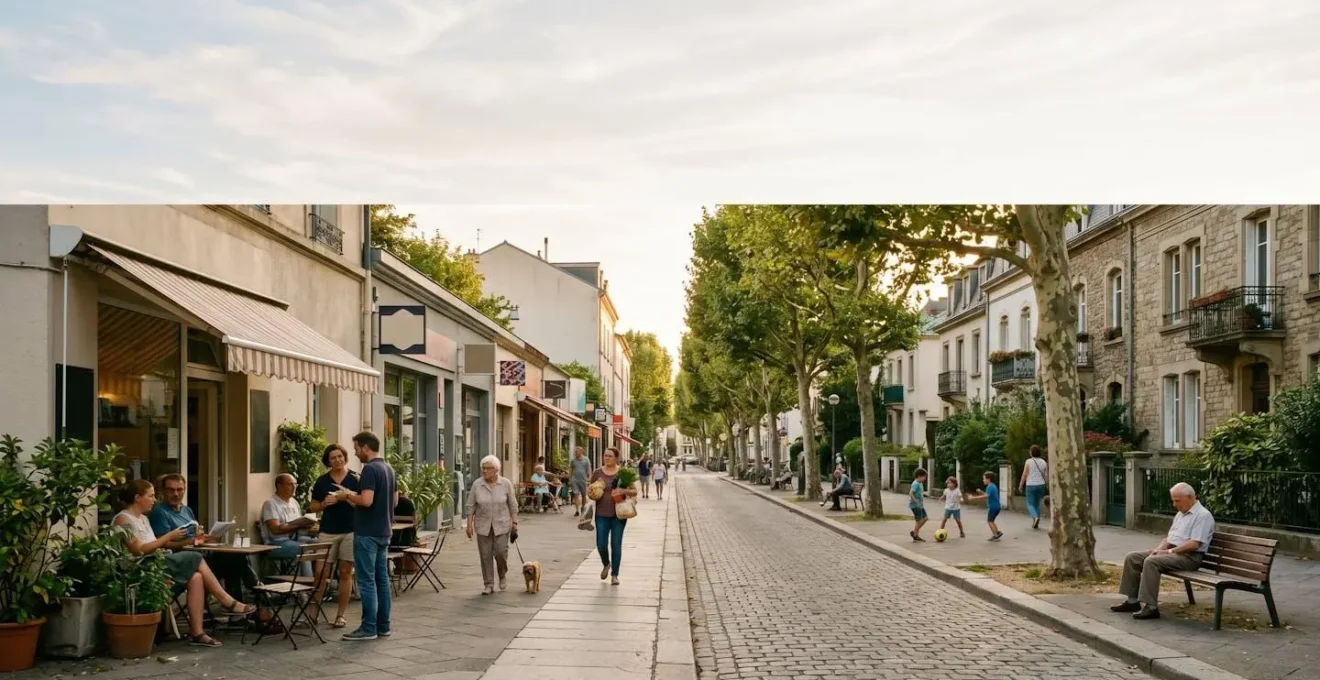
Living like a local isn’t about following a checklist of activities, but about learning to read and integrate into a city’s hidden operational systems.
- The search for « authenticity » often leads to gentrified, pre-packaged experiences—the very thing you’re trying to escape.
- Genuine immersion comes from understanding a neighbourhood’s daily rhythms, social hubs (« third places »), and spatial logic, rather than just its location on a map.
Recommendation: Shift your focus from « what to see » to « how to live. » Prioritise building small, daily routines in a residential area over ticking off landmarks.
The desire is familiar to any seasoned traveller: you land in a sprawling metropolis like Rome or Tokyo, and you want to bypass the curated, shrink-wrapped version of the city. You yearn for the genuine article—the morning rush at a neighbourhood bakery, the quiet hum of a park frequented only by residents, the unwritten rules of its public transport. The common advice is to rent a residential apartment, shop at local markets, and avoid the main squares. But in an era of global connectivity, this playbook is becoming increasingly obsolete. The « undiscovered » neighbourhood you found on a blog is often already on the fast track to becoming the next tourist hotspot.
The fundamental misunderstanding is that living like a local is a set of actions. It’s not. It’s a mindset rooted in urban anthropology. It’s about decoding a city’s invisible infrastructure: its social rhythms, its community hubs, and the very psychology of its spaces. The line between an authentic cultural enclave and a theme park for tourists is blurring, and navigating it requires a more sophisticated approach. Falling into the authenticity trap—confusing grit with genuineness or poverty with culture—can not only lead to a superficial experience but can also be disrespectful and, in some cases, unsafe.
This guide moves beyond the platitudes. We will not give you a simple list of « things to do. » Instead, we will equip you with a framework for reading a city’s underlying systems. We will explore why once-alternative districts now feel like tourist attractions, how to navigate using local knowledge instead of tourist maps, and why the feeling of a space can be more important than its size. Ultimately, you will learn to see the city not as a collection of sites, but as a living organism you can temporarily become a part of.
This article provides a deep dive into the strategies and mindset required for genuine urban immersion. The following sections break down how to decode a city’s character, from its neighbourhood dynamics to its hidden historical layers, enabling you to craft a truly local experience.
Summary: A Guide to Authentic Urban Immersion
- Why Do Berlin’s « Alternative » Neighbourhoods Feel Like Tourist Attractions Now?
- How to Navigate Major Cities Using Local Knowledge Instead of Tourist Routes?
- Tourist District Hotels vs Residential Neighbourhood Apartments: Which Reveals Cities Better?
- The Urban Authenticity Trap That Puts You in Genuinely Dangerous Situations
- How Many Days Do You Need in a City to Experience It Beyond Tourist Level?
- How to Walk Ancient Roman Roads Through Modern Cities for Immersive History?
- Why Do Some 40m² Flats Feel Bigger Than 60m² Apartments?
- How Can You Experience Ancient European Cities Beyond Surface-Level Tourism?
Why Do Berlin’s « Alternative » Neighbourhoods Feel Like Tourist Attractions Now?
The story of Berlin’s neighbourhoods like Kreuzberg and Neukölln is a perfect case study in the « authenticity-gentrification pipeline. » What were once affordable, gritty districts, defined by their working-class and immigrant communities, have become the epicentre of a specific brand of tourism. The very « authenticity » that made them attractive—the street art, the corner pubs (Kneipen), the edgy vibe—has been commodified, polished, and sold back to visitors. This process was accelerated after the fall of the Wall, when these former border zones suddenly became centrally located, attracting artists, students, and eventually, investors and international visitors.
This transformation is driven by powerful demographic and economic shifts. Research on Berlin’s evolution shows that from 2012 to 2017, Berlin grew by over 243,000 people, 81% of whom were foreigners. This influx creates immense demand for housing and services, pushing out long-term residents and replacing local businesses with yoga studios, third-wave coffee shops, and vintage stores catering to a global aesthetic. The « alternative » neighbourhood becomes an attraction in itself, its character preserved as a kind of living museum exhibit. The street art that was once a form of protest becomes a backdrop for Instagram photos.
For the traveller seeking genuine immersion, this presents a paradox. You arrive in a neighbourhood famed for its raw, creative energy, only to find it feels like a curated experience, populated by people just like you. Recognising this gentrification pipeline is the first step toward finding true local life. It requires looking beyond the « coolest neighbourhood » lists and seeking out areas where the urban rhythm is dictated by residents’ daily needs, not by the tourist economy.
How to Navigate Major Cities Using Local Knowledge Instead of Tourist Routes?
To escape the tourist bubble, you must abandon the tourist’s map—both literally and metaphorically. A tourist map shows you points of interest; a local’s mental map is built around routines, transport nodes, and social hubs. The key to developing this map is to focus on identifying what urban sociologist Ray Oldenburg famously called « third places. » These are the spaces where community life unfolds, distinct from the private realm of home (the « first place ») and the structured environment of work (the « second place »).
As Oldenburg explained in his seminal work, « The Great Good Place »:
Third places host the regular, voluntary, informal, and happily anticipated gatherings of individuals beyond the realms of home and work.
– Ray Oldenburg, The Great Good Place
Instead of navigating from monument to monument, navigate from one potential third place to another: a local library, a non-chain café with regulars, a park bench with a good view of a crossroads, a neighbourhood pub. These are the stages where the city’s daily life is performed. Observing these urban rhythms—the morning coffee rush, the after-school park gatherings, the evening dog-walkers—is far more revealing than visiting another landmark. This requires using technology not as a tour guide, but as a local would: to find practical solutions and community information.
Leverage digital tools to tap into this resident-level knowledge. Use the « Local Guides » lists on Google Maps to find curated spots by people who actually live there, not just sponsored venues. Explore neighbourhood-specific Facebook groups or forums to see what events are happening. Ditch the tourist-oriented transport app for the official city transit app that locals use. By focusing your exploration around the social infrastructure of a neighbourhood rather than its sightseeing checklist, you begin to see the city through a resident’s eyes and build a more authentic mental map.
Tourist District Hotels vs Residential Neighbourhood Apartments: Which Reveals Cities Better?
The default advice for « living like a local » has long been to choose a short-term apartment rental over a hotel. The logic is compelling: a kitchen allows you to shop at local markets, and a residential address forces you out of the tourist core. While this holds some truth, the reality has become far more complex. The explosion of vacation rentals has, in many cities, hollowed out the very neighbourhoods they are meant to give access to. When entire apartment blocks become de facto hotels, you are no longer living among locals; you are living among other travellers, serviced by a transient economy.
This isn’t just a feeling; it has a measurable and often devastating impact on community life. A 2023 study in Spain, for instance, revealed the profound effect of this trend. It found that the proliferation of vacation rentals led to a 77.7% increase in housing prices and a 68.4% deterioration in neighbourhood life at a national level. This creates « tourist ghettos » where local bakeries are replaced by luggage storage shops and the sound of rolling suitcases is more common than children playing. In this context, an apartment may offer the illusion of local living but places you in an environment just as artificial as a hotel district.
The key isn’t the type of accommodation, but its context and the routines it enables. As one nomadic family observed, true immersion comes from everyday engagement:
Living like a tourist full-time is extremely expensive. Nomadic families learn to live like locals in major cities by engaging in everyday activities. Wanting to live like a local is as easy as striking up a conversation—ask any worker at a landmark where they eat on weekends, and their favorite spots are likely at transit stops where tourists have no reason to get off.
– Veronica Hanson, veronicahanson.com
A carefully chosen small hotel or guesthouse on the edge of a truly residential district can be more immersive than an Airbnb in a gentrified « cool » area. The best choice is the one that facilitates mundane routines: having a go-to café, a regular route through a park, or a familiar newsstand. It’s these small, repeated interactions that build a sense of place, not the presence of a stovetop you may never use.
The Urban Authenticity Trap That Puts You in Genuinely Dangerous Situations
There is a dangerous naivety in the quest for « raw » and « unspoiled » urban experiences. This is the authenticity trap: the tendency for travellers, often unconsciously, to equate poverty, decay, or social marginalisation with authenticity. Driven by what researchers call an « adventurer’s ego, » this mindset can lead you to misinterpret complex social situations and wander into genuinely unsafe environments. A neighbourhood isn’t « more authentic » because it’s impoverished or lacks infrastructure; it’s simply a place where people live, often under difficult circumstances.
Viewing such areas as a spectacle for your own cultural consumption is not only ethically questionable but can also create friction. This phenomenon, sometimes termed « poverty tourism, » commodifies the lives of residents and can be perceived as deeply disrespectful. True local life is not about finding the most « gritty » street; it’s about observing the signs of a healthy, functioning community, regardless of its wealth.
Case Study: The Commodification of Poverty
The search for authentic experiences can lead travelers into what is known as « slum tourism. » As outlined in research on cultural commodification, this quest is often driven by a « savior complex, » where the traveller feels they are gaining a more « real » insight. However, this dynamic creates significant ethical problems around consent and power, as the « authenticity » being consumed is often a performance for tourists, and the experience can lead to dangerous misunderstandings between visitors and local communities who feel their lives are being exoticized.
So, how do you explore off the beaten path safely? By learning to read the universal signs of a safe, vibrant neighbourhood, a concept urbanist Jane Jacobs called « eyes on the street. » A safe residential area is one with a mix of people out and about at different times of day—children playing, elderly residents sitting on benches, people walking their dogs. It has well-lit public spaces and small businesses with their lights on in the evening. A deserted street, even in a wealthy area, is often less safe than a bustling, lower-income street where a strong community fabric provides natural surveillance.
Your goal is to be a respectful observer, not an intruder. Pay attention to the social atmosphere. Do people make eye contact and nod, or do they look away? Is the street life relaxed and varied, or tense and uniform? These are the real indicators of a neighbourhood’s character and your permission to explore it.
How Many Days Do You Need in a City to Experience It Beyond Tourist Level?
The question of how long to stay in a city to « live like a local » is misleading. A month-long trip can feel just as superficial as a weekend if you spend it hopping between tourist sites. Conversely, even a few days can be deeply immersive if you focus on building familiarity through routine. The key is not the duration, but the intention. It is about creating habits that ground you in a place, however temporarily.
Many travellers fall into the trap of trying to « see everything, » resulting in a frantic, surface-level tour. The antidote is to slow down and build a sense of belonging through repetition. As travel writer Matthew of Little Grey Box notes, the challenge is to consciously break from your home patterns:
It’s very possible to travel across the planet only to recreate the same routines you had at home. The antidote is a simple one: build habits that push you out the door.
– Matthew (Little Grey Box), How to live like a local when you travel
A stay of five to seven days is often an ideal minimum for this approach. It’s long enough to establish a « home base » neighbourhood and build a few simple routines without the pressure of a long-term stay. The first two days might be for orienting and seeing one or two « must-see » sites to get them out of your system. The following days, however, should be dedicated to exploring your chosen neighbourhood and one or two adjacent ones. This is where you can apply the « Rule of Three »: visit three local bakeries, three different parks, or three neighbourhood markets. This comparative approach reveals the subtle nuances of local life much more than a single visit does.
The goal is to create a small, temporary life for yourself. Find a morning coffee spot. Discover a favourite park bench. Take a different route « home » each evening. These small acts of repetition transform you from a visitor passing through to a temporary participant in the neighbourhood’s daily life. It is this familiarity, not the number of days, that creates the feeling of living locally.
Your Action Plan: Building a Sense of Belonging Quickly
- Find a local club: Use Instagram or local community boards to find a run club, book club, or sports group; this provides an instant community connection.
- Establish a morning ritual: Visit the same café or take the same walk through a local park each morning to build familiarity and become a recognizable face.
- Apply the ‘Rule of Three’: Intentionally experience three non-chain versions of one thing, like three neighbourhood bakeries or three local markets, to understand local variations.
- Build post-work exploration habits: After your main activity for the day, explore a new street or neighbourhood with intention instead of heading straight back to your accommodation.
- Take the long route home: Deliberately wander down unfamiliar streets and into small shops to discover the hidden layers of your chosen neighbourhood.
How to Walk Ancient Roman Roads Through Modern Cities for Immersive History?
Experiencing a city like a local isn’t just about a city’s present; it’s also about understanding how its past physically shapes its current form. In many European cities, the most profound way to do this is to trace the « ghosts » of ancient infrastructure. This is the ultimate expression of reading a city’s spatial logic—seeing the 2,000-year-old blueprint beneath the modern metropolis. You don’t need an archaeology degree; you just need to know what to look for.
Roman roads, for example, were famously straight. When you see an unusually direct, straight street cutting diagonally across a medieval or modern grid in a city like London (Watling Street), Cologne, or Lyon, you are very likely walking on a path laid down by Roman engineers. These ancient arteries often persist as major thoroughfares today. As urban historians note, this influence is deeply embedded in the urban fabric:
Roman engineering still dictates modern city layouts, with unusually straight streets cutting across medieval grids and major churches built on former pagan temple sites.
– Urban Planning Historical Analysis, Historical urban development patterns
This principle extends beyond roads. The location of a city’s main cathedral is often no accident; many were built directly on top of the ruins of a Roman forum’s main temple, co-opting a site of ancient power. The old Roman walls often dictate the boundary of a city’s « old town, » and their former gates (like Ludgate or Newgate in London) remain as place names, marking the historical entry points. By using a historical map overlay (many apps provide this) or simply looking for these clues, you can start a walk in a modern business district and end up on a path that legionaries once marched.
This practice transforms a simple walk into an act of time travel. You begin to see the city in layers, understanding why a certain street is where it is, or why a public square has its particular shape. It connects you to the deep history of a place in a physical, tangible way that no museum visit can replicate. It’s an advanced technique for local immersion, moving beyond social rhythms to deciphering the city’s very bones.
Why Do Some 40m² Flats Feel Bigger Than 60m² Apartments?
When choosing a temporary « home » in a city, we often focus on metrics: square metres, number of bedrooms, distance from the city centre. Yet, as anyone who has lived in a city knows, the objective size of a space is often less important than its perceived size. The psychology of space plays a crucial role in how we experience « living » somewhere. A well-designed 40m² flat can feel more expansive and restorative than a poorly laid-out 60m² apartment. For the traveller aiming for immersion, understanding these principles is key to choosing a base that feels like a sanctuary, not a box.
The single most important factor influencing perceived space is natural light. Large windows, a high floor, or a dual aspect (windows on two different walls) can make a small space feel open, airy, and connected to the outside world. A dark, ground-floor apartment, no matter its size, can feel claustrophobic and isolating, cutting you off from the rhythm of the city’s day. The quality of light—the way it moves across a room from morning to evening—is a fundamental part of the « living » experience.
Beyond light, a sense of « prospect and refuge » is vital. This is our innate preference for spaces where we can see out (prospect) while feeling safe and enclosed (refuge). A small apartment with a balcony, a large window with a deep sill, or even just a clear view over rooftops provides this sense of prospect. It connects your private space to the public realm, allowing you to observe the city’s life from a place of comfort. Other factors include high ceilings, which create a feeling of vertical space, and an efficient layout that minimizes wasted space like long, dark corridors.
When browsing for accommodation, look beyond the square meterage. Analyse the photos for the quality of light. Check the floor plan for a logical flow and lack of dead space. Look for access to a balcony or a significant view. Choosing a smaller, brighter, more intelligently designed space will have a far greater positive impact on your trip than simply opting for the largest flat you can afford. It’s about finding a place that supports your well-being and enhances your connection to the city outside.
Key Takeaways
- « Authenticity » is a moving target; what is advertised as alternative is often already a commodified tourist experience.
- True local immersion comes from decoding and participating in a city’s daily rhythms, not from a checklist of sights.
- The right accommodation is not about size or type (hotel vs. apartment) but about its ability to facilitate daily, mundane routines within a living community.
How Can You Experience Ancient European Cities Beyond Surface-Level Tourism?
Experiencing an ancient city like Prague or Lisbon presents a unique challenge. The very history that makes them so compelling has also turned their cores into highly efficient tourism machines. Here, the « authenticity-gentrification pipeline » has been at work for decades, if not centuries. Old factories that once housed workers are now boutique hotels, and docks once used by fishermen are now home to nightclubs. The historical fabric of the city becomes a backdrop, a stage for a globalized form of consumption where the experience is predictable and standardised.
To break through this surface, you must synthesize all the strategies we’ve discussed. It requires a conscious effort to see the city on different terms, operating on a different schedule from the average tourist. This means engaging in what could be called off-peak urban exploration. For example, visiting an iconic landmark like Prague’s Charles Bridge at dawn allows you to see it as locals do: a quiet, atmospheric transit route, not a crowded marketplace. Witnessing a market square as vendors set up their stalls in the early morning reveals the logistical choreography of the city that is invisible by mid-day.
This approach also involves seeking out institutions of historical continuity. Instead of just looking at old buildings, engage with places that have been in continuous use for centuries. Attend a lecture at a university founded in the 13th century, visit a pharmacy that has been operating since the 1700s, or attend a service in a church that has held them for 800 years. These are not static museums; they are living threads connecting the city’s past to its present. You can also trace modern « guilds »—streets of specialised businesses like musical instrument makers or artisan bookbinders—that echo the medieval organisation of crafts.
Ultimately, experiencing an ancient city authentically is an act of imagination, grounded in deliberate observation. It’s about combining an understanding of spatial logic (tracing Roman roads), an appreciation for urban rhythms (exploring financial districts after work hours), and a commitment to building your own temporary routines. By doing so, you move from being a passive consumer of the city’s history to an active participant in its ongoing, living story.
To put these concepts into practice, the next logical step is to start planning your trip not around destinations, but around routines and neighbourhood characteristics. Begin your research by identifying potential « third places » and residential areas that exist outside the well-trodden tourist paths.