Contrary to popular belief, simply ‘shopping local’ is not enough to ensure your travel money supports communities; the real key is to understand and bypass the hidden systems of economic leakage that divert funds away.
- All-inclusive resorts and online booking giants can extract up to 80% of tourist spending from a local economy before it ever touches local hands.
- Truly ethical travel involves actively vetting businesses for local ownership and direct community benefit, moving beyond superficial ‘green’ labels.
Recommendation: Shift your focus from just visiting landmarks to engaging with the local ‘living economy’—seek out independent guesthouses, community-run tours, and artisan workshops to ensure your money circulates and multiplies locally.
As a conscious UK traveller, you’ve likely felt the disconnect. You stand in a stunning destination, surrounded by vibrant culture, yet the sterile efficiency of your international hotel chain or the generic souvenir shop feels hollow. You want your spending to empower the people whose home you’re visiting, not just enrich a distant corporate headquarters. The common advice— »eat local, » « buy from artisans »—is a good start, but it barely scratches the surface of a complex system designed to do the opposite.
The tourism industry is rife with « value extraction points. » These are mechanisms, often invisible, that siphon money out of a destination. This includes the high commissions charged by global online travel agencies, the foreign-owned supply chains that stock hotel restaurants, and the repatriated profits of multinational corporations. The result is a phenomenon known as « economic leakage, » where the vast majority of the money you spend leaves the country, leaving local communities with low-wage jobs and strained resources instead of genuine economic development.
But what if the solution wasn’t just a different set of spending choices, but a different way of seeing? This guide moves beyond the platitudes. It provides you with a framework to deconstruct the tourism supply chain, identify these extraction points, and make deliberate choices that actively channel your funds into the hands of local people. It’s about shifting from a passive consumer to an active, informed economic partner in the places you visit. We will explore the mechanics of leakage, provide tools to find genuinely local businesses, and reframe your entire approach to travel spending.
This article provides a complete framework for understanding and acting. The following sections will guide you through the core problems and their practical solutions, empowering you to make a real difference with every trip.
Summary: A Traveller’s Handbook to Funding Local Economies, Not Corporations
- Why Do All-Inclusive Holidays Leave Locals Poorer Despite Tourist Presence?
- How to Find Truly Local Businesses When Booking Travel Online?
- Group Tours vs Independent Travel: Which Puts More Money in Local Hands?
- The Slum Tour Trap That Exploits Communities Under the Guise of Education
- When Should You Avoid Destinations Suffering From Overtourism?
- How to Spot Greenwashing and Find Actually Sustainable Brands?
- The Tourist Mistake of Seeing Colosseums but Missing Ancient Daily Life Spaces
- How Can You Make Ethical Purchases Without Doubling Your Living Costs?
Why Do All-Inclusive Holidays Leave Locals Poorer Despite Tourist Presence?
The image is tempting: a single payment for a wristband that unlocks unlimited food, drink, and entertainment within a walled paradise. Yet, this model is a primary driver of economic leakage, the mechanism by which tourist money fails to reach the local community. These resorts are often foreign-owned, import many of their supplies from international distributors, and repatriate their profits. The money you spend checks in and checks out of the country almost as quickly as you do.
The scale of this problem is staggering. For many popular destinations, the majority of tourism revenue never enters the local economy. A United Nations report highlighted that tourism leakage can reach as high as 80% in Caribbean countries, with similar figures in other resort-heavy regions. This means for every £100 you spend, as little as £20 might stay to pay local wages, support local farmers, or fund public services. The rest is « leaked » out to pay for imported goods and foreign ownership profits.
This reality creates a paradox where a destination can appear to be booming with tourists while local poverty and lack of opportunity persist. As Jamaica’s tourism minister Edmund Bartlett stated in a parliamentary debate, this leakage is an « unacceptable situation if we are serious about expanding the benefits of the sector to more ordinary Jamaicans. » His comments underscore the frustration of seeing vast wealth generated by tourism flow right past the people who make the experience possible.
Case Study: Jamaica’s Fight Against Leakage
In response to this challenge, Jamaica established a Tourism Linkages Network to forge stronger connections between the tourism sector and local producers. An initiative called the Agro-Tourism Farmer’s Market, for example, provides a platform for local farmers to sell produce directly to hotels and tourists. According to an analysis featured on Matador Network, these markets now generate millions of dollars in annual revenue, demonstrating that targeted strategies can successfully plug the leaks and redirect tourism spending back into the community.
While some resorts are making genuine efforts to source locally, the fundamental structure of the all-inclusive model is geared towards keeping guests—and their money—on-site. A more impactful approach involves stepping outside these walls and engaging directly with the local economy.
How to Find Truly Local Businesses When Booking Travel Online?
In the digital age, your first interaction with a local business is often through a third party. Major Online Travel Agencies (OTAs) like Booking.com or Expedia have become the default for finding accommodation, but they are a significant point of value extraction. These platforms act as global gatekeepers, and for the convenience they offer, they charge local guesthouses, B&Bs, and small hotels a hefty price. This fee is a direct hit to the local economy.
Research shows these platforms can charge commissions of 15-30% of the booking value. On a £500 stay, that’s up to £150 that leaves the community before you even arrive. The most powerful action you can take is to use these platforms for research, but then make the extra effort to find the business’s own website and book directly. This simple act ensures 100% of your payment goes to the people running the establishment.
Finding that direct link requires a bit of digital detective work. Many large platforms actively try to hide direct contact information. Look for the property’s name and its town, then use a search engine with terms like « official site » or « book direct. » Check the « About Us » page for the owner’s story and a physical local address, not just a corporate PO Box. This is where you connect with the real people behind the business, moving from a sterile transaction to a human-to-human agreement.
This act of research is more than just a cost-saving measure for the business owner; it’s a statement. It tells the owner that you value their independence and want to support them directly. Often, you’ll find they offer a better rate or a small perk for booking direct, as they’re happy to pass on some of the savings from the commission they’ve avoided paying.
To help you distinguish the truly local gems from the corporate-backed facades, here are some key indicators to look for during your online research:
- Verify a physical local address and phone number (not just a corporate headquarters).
- Check the ‘About Us’ page for owner names and their connection to the destination.
- Look for a direct booking website, not just listings on international platforms.
- Use advanced search operators like ` »business name » official site` to find direct booking pages.
- Confirm local domain extensions where applicable (e.g., .co.uk, .fr, .it).
This extra five minutes of searching is one of the most significant contributions you can make to ensuring your travel budget benefits the local community directly.
Group Tours vs Independent Travel: Which Puts More Money in Local Hands?
The choice between joining an organised group tour and charting your own path as an independent traveller has significant implications for local economies. While large, multinational tour companies offer convenience, they often replicate the economic leakage model of all-inclusive resorts on a mobile scale. They use foreign-owned bus companies, partner with international hotel chains, and shepherd tourists to restaurants and shops that have paid for the privilege, with profits flowing back to the company’s home country.
Independent travel, by its nature, forces you to engage with the local economy at almost every step. You buy a ticket from the local bus station, grab a snack from a street vendor, hire a local guide for a specific site, and sleep in a family-run guesthouse. Each of these small, direct transactions injects money into different parts of the community, creating a much wider and more equitable distribution of your travel spending. Your money doesn’t just go to one tour operator; it supports dozens of small entrepreneurs.
The difference in economic impact is not trivial. It’s a matter of magnitude. Powerful research from the Adventure Travel Trade Association found that it takes 96 cruise tourists to generate the same $10,000 for a local economy as just four adventure tourists. This stark comparison highlights that the *type* of tourism is as important as the volume. A few independent, mindfully-spending travellers can have a far greater positive impact than a busload of tourists on a pre-packaged itinerary.
This isn’t to say all group tours are exploitative. A growing number of small, locally-owned tour operators are creating incredible experiences that are deeply rooted in the community. These companies are run by locals, employ local guides, use local transport, and eat at local restaurants. The key is to apply the same vetting principles you’d use for accommodation: who owns this company? Where are they based? Where do their profits go? Choosing a small-group tour run by a local entrepreneur can be a fantastic way to get off the beaten path while ensuring your money stays where it’s needed most.
Ultimately, the choice hinges on control. Independent travel gives you complete control over your spending, while a good local tour operator ensures that control is in the hands of someone with the community’s best interests at heart.
The Slum Tour Trap That Exploits Communities Under the Guise of Education
The rise of « slum tourism » or « poverty tours » presents one of the most complex ethical dilemmas for the conscious traveller. Marketed as a way to understand social realities and support marginalised communities, these tours can easily devolve into voyeuristic and exploitative experiences. The core danger lies in turning residents into passive exhibits for tourist consumption, reinforcing stereotypes rather than challenging them, and seeing profits flow to outside operators with little to no benefit for the community being observed.
The crucial question is one of agency and dignity. Who is telling the story? Who is profiting? A tour led by an external guide who parachutes in and out is fundamentally different from an initiative developed, owned, and run by the community members themselves. True community-based tourism puts residents in control of the narrative, the operations, and, most importantly, the revenue. However, even well-intentioned initiatives can fail. A study of a community-based tourism project in Vicos, Peru, revealed that without direct decision-making control, tourism can exacerbate internal tensions and reinforce existing power imbalances, with an external NGO controlling the benefits.
Your Ethical Tour Audit: 5 Questions to Ask Before You Book
- Points of contact: Who is telling the community’s story—external guides or residents themselves? Are residents active participants or passive subjects for photography?
- Collecte: Is photography restricted or regulated to protect residents’ dignity and privacy? Can you verify where the profits go?
- Cohérence: Does the tour include a genuine educational component that challenges stereotypes rather than reinforcing them? Is this aligned with the company’s stated mission?
- Mémorabilité/émotion: Does the tour connect visitors with community-run cooperatives or social enterprises for post-tour support, creating a lasting impact beyond the visit?
- Plan d’intégration: Are residents involved in decision-making about how the tour operates and evolves? Is there a clear mechanism for community feedback and control?
A responsible tour should feel less like a tour and more like a hosted visit. It should include an educational component that explains the systemic causes of poverty, not just its symptoms. It should create opportunities for genuine, respectful interaction, not just observation from behind a bus window. And critically, there must be a transparent and verifiable channel for tour profits to fund specific community projects, such as schools, health clinics, or business start-ups, with the community deciding on those priorities.
If you cannot find clear and convincing answers to these questions, the most ethical choice is often to steer clear and instead support community-run artisan cooperatives or social enterprises where the economic exchange is clear and dignified.
When Should You Avoid Destinations Suffering From Overtourism?
The conversation about ethical spending must also include a more difficult question: when is the most responsible act to not go at all? Overtourism occurs when the sheer volume of visitors begins to degrade the environment, strain local infrastructure, and erode the quality of life for residents. In these « critical-stage » destinations, your presence, no matter how well-intentioned your spending, can contribute more to the problem than to the solution.
The signs of critical-stage overtourism are often hiding in plain sight. It’s the city centre where every shop sells the same mass-produced souvenirs and you can’t find a local bakery or pharmacy. It’s the residential streets where traditional apartments have been converted en masse into short-term holiday lets, pushing out families and driving up housing costs. It’s the constant strain on water, waste management, and public transport systems that were never designed to handle such a massive, temporary influx of people. In these places, local residents can feel like strangers in their own homes, pushed to the periphery by the tourism monoculture.
As the travel guide Practical Wanderlust astutely notes, « Understanding where a destination falls in that tourism cycle helps to understand the impact of your presence, and how it may be perceived by local communities. » In the early stages, your visit is a welcome economic boost. In the critical stage, it can be another burden. The key is to learn to read these signs:
- Lack of businesses catering to residents (e.g., schools, grocery stores) in central areas.
- Rental and Airbnb listings vastly outnumbering residential housing options.
- Visible strain on local infrastructure (waste, water, public transport).
- Community protests or visible anti-tourism sentiment.
- Housing costs that have displaced long-term residents.
Choosing to avoid a destination during its peak season, or altogether in favour of a less-visited « second city » or region, is a powerful act of responsible tourism. It relieves pressure on the overburdened destination and brings much-needed economic activity to a place that will genuinely welcome it. This strategic choice helps distribute the benefits of tourism more evenly and sustainably.
This doesn’t mean blacklisting beautiful places forever, but rather engaging with them more intelligently—visiting in the off-season, staying longer, and venturing beyond the crowded epicentres.
How to Spot Greenwashing and Find Actually Sustainable Brands?
As travellers have become more conscious, companies have become more adept at using the language of sustainability as a marketing tool. « Greenwashing » is the practice of making vague, misleading, or unsubstantiated claims about the environmental or social benefits of a product, service, or company. You’ll see it in hotels that ask you to reuse your towels to « save the planet » while having no meaningful water conservation policy, or tour companies that use words like « eco, » « green, » and « responsible » without any evidence to back it up.
Cutting through this marketing fog requires a shift from taking claims at face value to actively seeking out proof. The most reliable indicators of a truly sustainable or ethical business are transparency and third-party verification. A company that is genuinely committed to its principles will be open about its practices and willing to have them scrutinised by an independent body. Vague promises are a red flag; specific, measurable data is a green light.
Instead of being swayed by pretty pictures of nature on a website, look for concrete evidence. Does the company have a recognised certification like B Corp, Fair Trade, or an industry-specific eco-label known for its rigorous auditing process? Do they publish a Corporate Social Responsibility (CSR) or sustainability report on their website? If they do, read it. Look for specific goals and data on their progress, not just aspirational language. A truly ethical company will be transparent about its supply chain and its tax practices, understanding that you cannot claim to be sustainable while funnelling profits through offshore tax havens.
Here is a practical process for evaluating a company’s claims:
- Look for credible, third-party certifications (e.g., B Corp, Fair Trade).
- Search the company’s website for a CSR or sustainability report with specific, measurable data.
- Verify claims by checking for transparent supply chain information.
- Investigate tax practices; use of tax havens is a major red flag.
- Cross-reference certification claims on the certifying organization’s official website.
- Look for evidence of ongoing commitment, such as multi-year progress tracking.
This investigative approach allows you to reward companies that are walking the walk, not just talking the talk, and to channel your money towards businesses that are genuinely contributing to a more equitable and sustainable world.
The Tourist Mistake of Seeing Colosseums but Missing Ancient Daily Life Spaces
A common trap for travellers is to focus exclusively on the « checklist » of major monuments—the Colosseums, the Eiffel Towers, the Great Walls. While these sites are historically significant, they often exist in a tourist bubble, economically disconnected from the contemporary life of the city. The businesses that surround them—souvenir shops selling mass-produced trinkets, generic cafes with inflated prices—are often the worst offenders when it comes to economic leakage. Your spending here is unlikely to benefit the wider community.
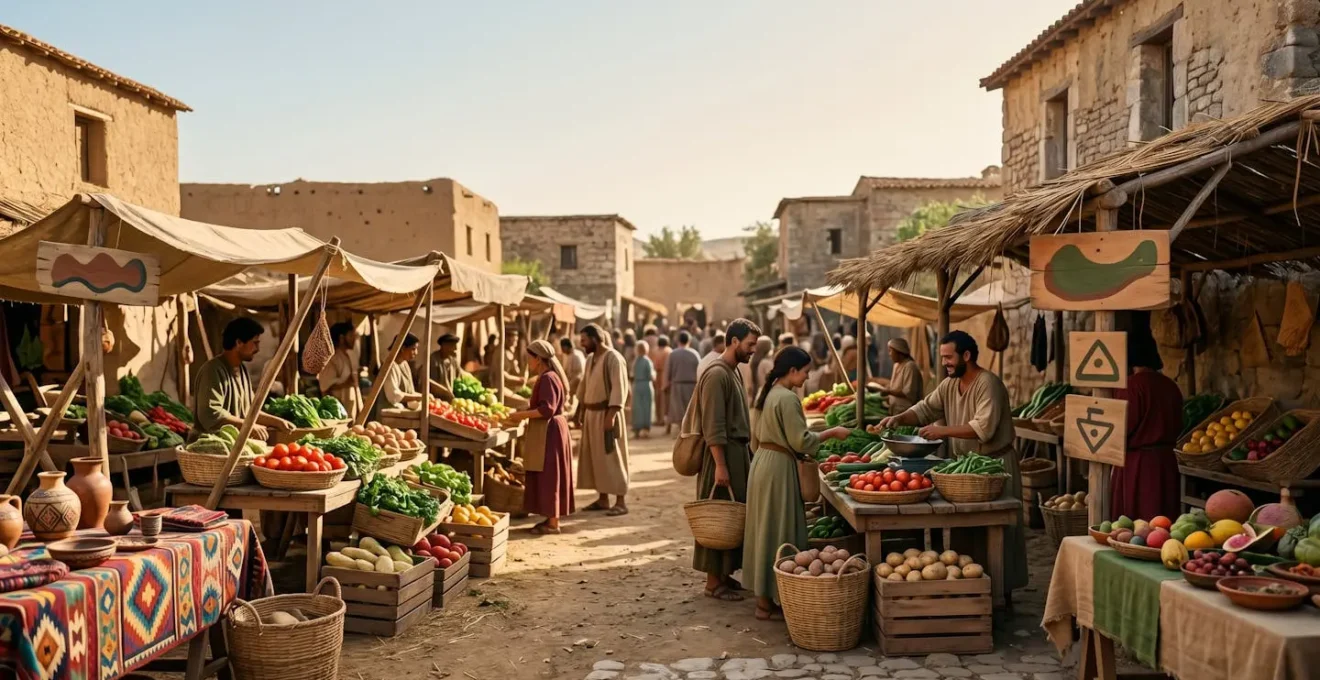
The alternative is to consciously shift your focus from the monumental to the mundane, from the ancient dead spaces to the modern living ones. The real culture and economy of a place are found in its artisan workshops, its neighbourhood markets, its local bakeries, and its family-run restaurants. These are the spaces of daily life where you can make purchases that have a direct and tangible impact. Buying a piece of pottery directly from the artisan who made it, a loaf of bread from the local baker, or a meal at a restaurant that sources from the nearby market ensures your money enters the local circulatory system.
This approach requires a change in mindset. Instead of asking « What are the top 10 things to see? » ask « Where do locals go to eat, shop, and live? » Seek out workshops where you can see a craft being practised, not just a shop where it is sold. Engage with the makers, hear their stories, and understand the value of their work. This not only leads to a more authentic and memorable travel experience but also transforms your role from a passive consumer of sights to an active supporter of a living culture and economy.
By thinking about your spending choices and supporting small, independent businesses, you’ll make a real difference to local communities, families and individuals.
– TravelLocal, Ethical tourism practices: how to respect boundaries
Supporting these human-scale enterprises is a direct investment in the preservation of local skills and cultural identity. It sends a clear market signal that there is a demand for authentic, locally-made goods, helping to counteract the tide of homogenised, mass-produced tourist tat.
Every pound spent in a local workshop or market is a vote for a more diverse, resilient, and equitable local economy.
Key takeaways
- Economic leakage is the single biggest obstacle to tourism benefiting local communities; up to 80% of your money can leave a destination without ever touching local hands.
- Bypassing Online Travel Agencies (OTAs) and booking directly with locally-owned accommodation is one of the most powerful actions you can take to combat leakage.
- True ethical tourism requires a critical mindset: you must question who owns a business, who tells the story on a tour, and whether a ‘sustainable’ label is backed by transparent proof.
How Can You Make Ethical Purchases Without Doubling Your Living Costs?
A persistent myth is that ethical or sustainable travel is a luxury reserved for those with deep pockets. In reality, the principles of channeling money into local economies often lead to more affordable and value-rich experiences. The expensive, leakage-prone models of tourism—all-inclusive resorts, luxury hotel chains, pre-packaged tours—are the ones that cost a premium. By deliberately stepping away from them, you often save money while increasing your positive impact.
Consider the data. A report from The Travel Foundation found that even high-end hotels in developing nations can have staggering leakage rates. It revealed 55% leakage for 4-5 star hotels in Bali, meaning a £2,000 holiday leaves only £900 in the local economy. By contrast, choosing to stay in a charming, locally-owned guesthouse for a fraction of the price ensures that nearly 100% of your accommodation cost stays local. Eating at a family-run restaurant is not only more authentic but almost always cheaper than the hotel buffet.
The key is to equate « value » not with luxury, but with impact and connection. An ethical approach to spending isn’t about spending *more*; it’s about spending *smarter*. It means prioritising direct transactions that cut out the middlemen. It means choosing experiences over packaged comfort. Taking the local bus instead of a private tour bus, buying fruit from the market instead of the hotel minibar, and drinking a coffee in a neighbourhood cafe are all choices that are both economically beneficial for the community and lighter on your wallet.
This is the ultimate win-win of conscious travel. You get a more authentic, memorable, and affordable trip, while the community you are visiting reaps the genuine economic benefits of your presence. It proves that aligning your travel with your values doesn’t require a bigger budget, but rather a greater sense of awareness and a willingness to engage with a place on its own terms.
Start today by applying this analytical lens to your next trip plan. By deconstructing the supply chain and making deliberate, direct choices, you can transform your role from a simple tourist into a genuine partner in local prosperity.