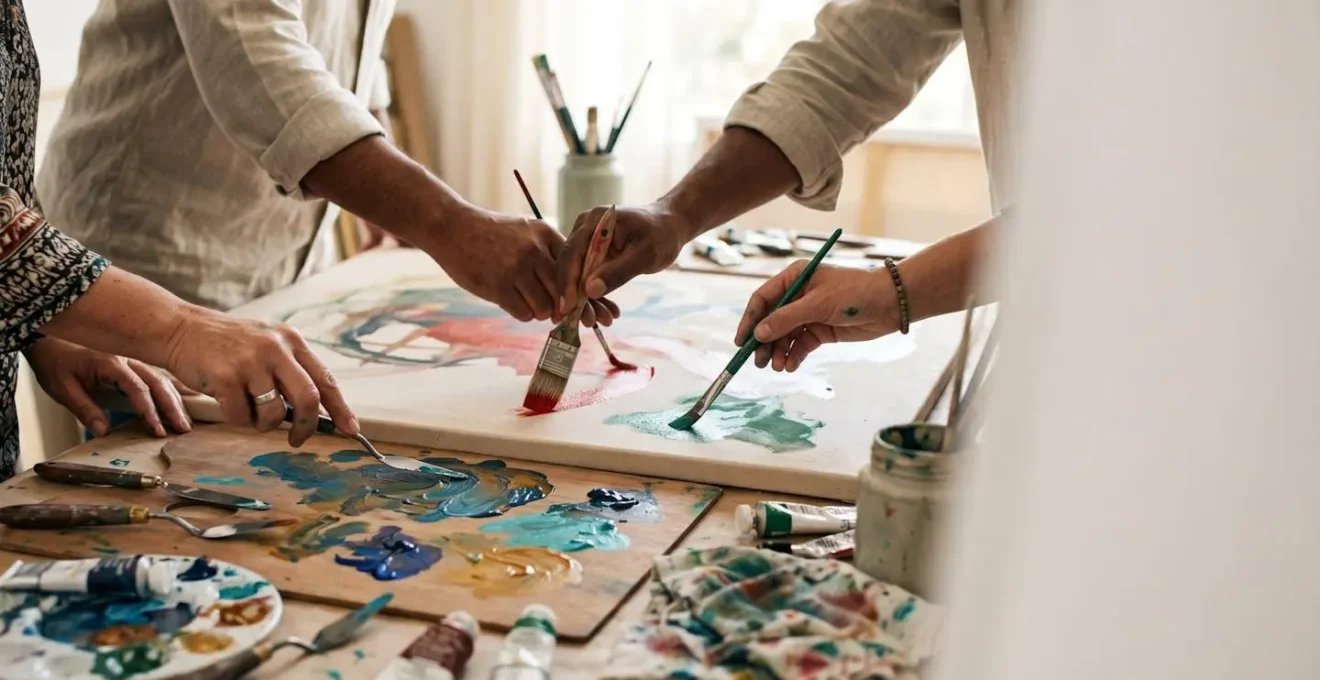
The feeling of emptiness from endless streaming isn’t a personal failing; it’s a direct result of a passive consumer mindset.
- Endless choice paradoxically leads to « cognitive fatigue » and devalues individual cultural experiences.
- Active creation or community involvement fosters deeper social connections and well-being than passive attendance.
Recommendation: Intentionally shift from seeking finished products to engaging with creative processes—even on a small scale—to transform cultural obligation into genuine personal connection.
You have access to virtually every film, album, and TV series ever made. You scroll through world-class art on your phone and watch theatre from your sofa. Yet, a persistent feeling of disconnection remains. You’re consuming more culture than any generation in history, but it feels less and less satisfying. If this sounds familiar, you are not alone. It’s a common experience for many UK adults who find themselves adrift in a sea of content, feeling more like spectators of life than active participants in it.
The conventional advice is often to simply « do more »—visit another museum, buy another ticket, subscribe to another service. This approach treats cultural engagement like a checklist to be completed. But this misses the point entirely. The issue isn’t a lack of cultural options; it’s that we’ve been conditioned to approach them with a consumer mindset, passively receiving finished products instead of actively engaging in the creative pulse of our communities.
What if the key to a richer cultural life wasn’t about consuming more, but about participating differently? This guide proposes a fundamental mindset shift: from being a passive consumer to becoming an active participant. It’s not about adding more to your schedule, but about changing your relationship with art, creativity, and the community around you. It’s about rediscovering the joy of involvement over the fleeting satisfaction of consumption.
This article will guide you through this transformation. We will explore why infinite choice feels so hollow, provide practical ways to find meaningful participation in your local UK city, and dismantle the psychological traps that turn culture into an obligation. By the end, you will have a new framework for building a cultural life that is not only enjoyable but genuinely restorative and connective.
To help you navigate this journey from passive consumption to active participation, this article is structured to address the core questions and barriers you might face. The following summary outlines the key areas we will explore.
Summary: From Cultural Consumer to Active Participant: A Guide
- Why Does Unlimited Streaming Feel Less Satisfying Than One Live Performance?
- How to Find Free or Affordable Cultural Participation in Your UK City?
- Making Art vs Attending Events: Which Creates Deeper Cultural Connection?
- The Cultural Productivity Trap That Makes Museums Feel Like Obligations
- When Should You Stop Forcing Yourself to Like Art That Does Not Move You?
- Why Do the Highest-Grossing Films Rarely Deliver the Deepest Emotional Impact?
- How to Discover Hobbies You Actually Want Versus Hobbies You Think You Should Want?
- How Can You Find a Hobby That Actually Relaxes You Instead of Adding Stress?
Why Does Unlimited Streaming Feel Less Satisfying Than One Live Performance?
The paradox of our modern cultural life is that unlimited access has not led to unlimited satisfaction. The feeling of emptiness after binge-watching an entire series or scrolling through endless playlists is a common phenomenon. This isn’t a sign of ingratitude; it’s a psychological response to what researchers call the « information abundance paradox. » When faced with infinite choice, the value of each individual choice diminishes. The experience becomes a low-stakes, low-investment activity, devoid of the anticipation and commitment that make an event meaningful.
A single live performance demands more from you. You have to book a ticket, travel to a venue, and share a physical space with other people. This investment creates a sense of occasion. You are present, focused, and part of a collective experience. The energy of the performers and the shared reactions of the audience create a feedback loop of emotion that is impossible to replicate through a screen. This is the difference between passive reception and active presence. This shared experience creates a powerful sense of connection and memory that a solo streaming session rarely can.
This feeling of being overwhelmed and dissatisfied by too much content is not just an opinion; it has a name: cognitive fatigue. As one research paper on the subject explains, this overload affects our ability to process information deeply. In their 2025 paper on « Epistemic Scarcity, » researchers highlight a key trade-off:
information abundance paradoxically degrades truth discernment, creating new opportunities for entrepreneurial foresight but also new forms of soft totalitarianism and cognitive fatigue
– Research on Epistemic Scarcity, Epistemic Scarcity: The Economics of Unresolvable Unknowns (2025)
Ultimately, the satisfaction from a live event stems from its scarcity and physicality. It is a unique moment in time that cannot be perfectly replicated. Streaming, by its nature, is designed for infinite replication. Shifting your focus towards experiences that are finite, shared, and require your physical presence is the first step in moving away from the consumer mindset.
How to Find Free or Affordable Cultural Participation in Your UK City?
The belief that cultural participation is expensive is a significant barrier for many. While high-end theatre or opera tickets can be costly, a wealth of vibrant, affordable, and even free opportunities exist in every UK city. The key is knowing where to look and shifting your focus from blockbuster events to grassroots community arts. These local initiatives are often where the most authentic participation happens.
Start by exploring council-funded arts centres, local libraries, and community hubs. These venues frequently host free workshops, open mic nights, art clubs, and local exhibitions. Websites like your local council’s page or community forums are excellent resources. Furthermore, many larger institutions offer concession schemes, pay-what-you-can evenings, or free entry to permanent collections. The UK government itself provides nationally representative data on engagement through its Participation Survey, which serves as a key evidence source for the Department for Culture, Media and Sport, helping to identify where opportunities are blooming.
Significant funding is directed towards making culture accessible. For example, Arts Council England actively funds projects to bring creativity to underserved communities. Their recent initiatives include grants of between £750,000 and £1 million available to support creative opportunities in 142 eligible UK locations. This means that new, accessible projects are constantly emerging, often specifically designed for beginners or those new to the area. Following organisations like the Arts Council or your regional arts body on social media can keep you informed of these new initiatives.
Action Plan: Auditing Your Local Cultural Landscape
- Points of Contact: List all potential cultural venues within a 30-minute radius: libraries, community centres, local theatres, pubs with event nights, and art galleries.
- Collecte: Spend one hour browsing their websites or social media. Inventory all free or low-cost (under £15) events for the next month: workshops, talks, open rehearsals, community choirs, etc.
- Coherence: Compare this list to your genuine interests, not what you think you *should* like. Does a pottery taster session excite you more than a history lecture? Be honest.
- Mémorabilité/Emotion: Identify one or two events that feel like an experience rather than a performance. A community garden art day? A storytelling night? Prioritise connection over prestige.
- Plan d’intégration: Choose just one event to attend in the next month. Book it. The goal is not to do everything, but to take one concrete step from observer to participant.
The goal isn’t just to find cheap entertainment, but to find an entry point into your local creative ecosystem. A free workshop might not have the polish of a West End show, but it offers something far more valuable: the chance to connect, create, and belong.
Making Art vs Attending Events: Which Creates Deeper Cultural Connection?
While attending cultural events is a valid form of engagement, the shift from consumer to participant truly crystallises when you move from being an audience member to a creator. The act of making art—whether it’s writing a poem, joining a choir, or learning three chords on a guitar—forges a fundamentally deeper connection to culture. It demystifies the creative process and transforms you from a passive admirer into someone with a stake in the game.
Creating something, no matter how amateur, gives you a new appreciation for the skill and effort behind the professional art you consume. You begin to understand the choices an artist makes, the challenges they overcome, and the vulnerability involved in sharing their work. This empathetic insight enriches your experience as an audience member. A visit to a gallery is no longer just about looking at paintings; it’s about understanding the struggle with colour, form, and meaning. This is the difference between spectatorship and solidarity.
Research consistently shows that active creation has a more profound impact on well-being and social connection than passive attendance. People who actively create are more likely to be involved in their communities. For instance, research from the National Endowment for the Arts found that while 42.0% of arts attendees reported participation in social groups, those who created art themselves participated in these groups at much higher frequencies. This suggests creation is a powerful catalyst for community building. As Polish health researchers noted when comparing active and passive engagement:
future research should investigate the causative influence of active participation in creative activities on health outcomes as, in contrast to passive attendance, it may be influential
– Polish Longitudinal Health Study Researchers, Cultural events – does attendance improve health?
You don’t need to aspire to be a professional artist. The goal is the process, not the product. The simple act of joining a local life drawing class, a writing group, or a community theatre troupe offers a built-in social structure and a shared purpose that watching a film at home can never provide.
The Cultural Productivity Trap That Makes Museums Feel Like Obligations
Have you ever walked through a museum, dutifully looking at every painting, but feeling a growing sense of fatigue and obligation? This is the « Cultural Productivity Trap. » It’s the internal pressure to consume culture as a form of self-improvement, turning what should be a joyful experience into another item on your to-do list. You’re not there to connect with the art; you’re there to « get it done, » to be able to say you’ve seen the exhibition. This mindset is the antithesis of genuine participation.
This trap is fed by a societal narrative that frames cultural consumption as a marker of sophistication. We feel we *should* see the latest blockbuster exhibition or the most-talked-about play. The experience becomes about social currency rather than personal resonance. This pressure is compounded by the economic reality of the arts. As a UK Parliament briefing notes, the creative sector is often presented as a key part of the economy, but for individuals, this landscape can be confusing, as « Culture and creativity are important parts of our economy, but resources, employment and provision are often fragmented, precarious and uneven. » This economic framing can inadvertently reinforce the idea of culture as a product to be consumed efficiently.
To escape this trap, you must give yourself permission to engage with culture on your own terms. Instead of trying to see everything in a museum, choose just three or four pieces that catch your eye and spend real time with them. Sit on the bench. Look closely. Ask yourself: What do I see? How does it make me feel? Ignore the audio guide and the wall text at first. Allow your personal, unfiltered reaction to be the primary experience. It is better to have a deep connection with one artwork than a superficial glance at one hundred.
This approach transforms the visit from a task to an exploration. It prioritises your internal experience over an external checklist. Let go of the need to « understand » everything and instead focus on what moves, challenges, or simply interests you. This is the first step toward reclaiming cultural spaces as places for personal reflection, not productivity.
When Should You Stop Forcing Yourself to Like Art That Does Not Move You?
The answer is: immediately. A core tenet of shifting from a consumer to a participant is honouring your own genuine response. Forcing yourself to appreciate art that leaves you cold is another symptom of the cultural productivity trap. It’s an act of intellectual submission, where you prioritise an external consensus (« this is a masterpiece ») over your own internal experience (« this does nothing for me »). True cultural engagement is not about agreeing with the critics; it’s about discovering what resonates with you personally.
Think of your taste in art like your taste in food or friends. It’s personal, subjective, and evolves over time. You wouldn’t force yourself to eat a food you dislike just because it’s on the menu of a famous restaurant. The same principle applies to culture. Giving yourself permission to dislike a celebrated film, walk out of a boring play, or skip a famous painting is incredibly liberating. It affirms that your emotional response is the most valid metric of engagement. This act of self-trust is a powerful move towards authentic participation.
This doesn’t mean you should retreat into a cultural echo chamber. It’s about the difference between being open and being obligated. You can be open to trying new things without feeling you must enjoy them. The goal is exploration, not conversion. When you encounter a piece of art that doesn’t connect, instead of faking appreciation, get curious about your reaction. Ask yourself *why* it doesn’t work for you. Is it the subject matter? The style? The tone? Analysing your disinterest can be just as insightful as analysing your enjoyment.
By trusting your own reactions, you begin to develop a more honest and personal relationship with culture. You stop chasing a vague ideal of sophistication and start curating a cultural life that genuinely nourishes and inspires you. Your taste is not « wrong »; it is simply yours. And in the world of art, that is the only opinion that should ultimately matter to you.
Why Do the Highest-Grossing Films Rarely Deliver the Deepest Emotional Impact?
Highest-grossing films are, by design, products for a global mass market. To achieve colossal box office success, they must appeal to the broadest possible audience, transcending cultural and linguistic barriers. This often requires them to operate on a principle of « cultural neutrality. » Storylines are simplified, emotional beats are universalised, and complex or challenging themes are sanded down to avoid alienating any significant demographic. The result is often a technically impressive but emotionally generic spectacle.
Deep emotional impact, however, is almost always born from specificity. It comes from stories rooted in a particular time, place, and cultural context. It arises from characters with unique, sometimes messy, motivations that feel real and relatable on a human level, even if their circumstances are unfamiliar. A blockbuster aims for universal appeal; an arthouse film or a local play often aims for specific resonance. The latter might connect deeply with a smaller audience precisely because it isn’t trying to be everything to everyone.
Research into media consumption confirms this. As a 2017 study published in PLOS One on cross-cultural video consumption found, local values remain a powerful filter for what we find engaging:
consumption of popular videos in culturally different countries appears to be constrained by cultural values. Cross-cultural convergence is more advanced in cosmopolitan countries with cultural values that favor individualism
– Cultural Values Research Team, Cultural values and cross-cultural video consumption on YouTube (PLOS One, 2017)
This explains why a low-budget independent film from your own country, or even a neighbouring one, might move you more profoundly than a billion-dollar Hollywood epic. It speaks a cultural shorthand you understand instinctively. To find deeper emotional impact, you must often look beyond the mainstream charts and seek out the stories being told on the margins—in independent cinemas, at film festivals, and by creators from your own community.
How to Discover Hobbies You Actually Want Versus Hobbies You Think You Should Want?
The pressure to be productive and « well-rounded » extends into our leisure time, turning the search for a hobby into another stressful task. We are bombarded with images of people mastering sourdough, running marathons, or becoming accomplished painters. This creates a list of « should-want » hobbies—activities we feel we ought to pursue for their social status or self-improvement benefits, rather than for pure, intrinsic joy.
The problem is choice overload. Just as with streaming services, the sheer number of potential hobbies can be paralysing. This phenomenon was famously demonstrated in the « Jam Study » by Professor Sheena Iyengar. When shoppers were presented with 24 varieties of jam, most were too overwhelmed to buy any. When the choice was reduced to 6, sales soared. The lesson is clear: an abundance of options can hinder decision-making. When you feel you *could* do anything, you often end up doing nothing, or you default to the most visible, « popular » choice.
To break free, you must tune out the external noise and listen to your own curiosity. What did you enjoy doing as a child, before you worried about being « good » at it? What topics do you find yourself reading about late at night? What small, quiet activities make you lose track of time? The answer to finding a hobby you *actually* want lies in these small signals of intrinsic motivation. It’s not about what sounds impressive, but about what feels genuinely engaging to you.
Start small and with low stakes. Instead of signing up for a 12-week pottery course, try a two-hour taster session. Instead of buying a professional camera, experiment with your phone. The goal is to « date » your hobbies, not marry them. Give yourself permission to try something and abandon it without guilt if it doesn’t click. The search is not for a new skill to master, but for a source of genuine, personal pleasure.
Key Takeaways
- Passive consumption of endless content leads to cognitive fatigue, while active, finite experiences create lasting memories.
- Active creation, even at an amateur level, builds deeper social and emotional connections than simply attending events.
- True engagement comes from trusting your personal response and abandoning the « cultural productivity trap » of doing what you feel you « should. »
How Can You Find a Hobby That Actually Relaxes You Instead of Adding Stress?
In our hyper-optimised world, even relaxation has become a source of stress. We choose hobbies that require new apps, complex equipment, or performance tracking, inadvertently adding another layer of cognitive load to our lives. A hobby that is meant to be a refuge from work can start to feel like another job, complete with its own pressures and metrics for success. This is the paradox of modern leisure: the tools we use to relax can end up stressing us out.
Dr. Philippa Hardman calls a related phenomenon the « Cognitive Offloading Paradox. » While discussing AI tools, her point applies perfectly to many modern hobbies. We think a tool will make things easier, but often it just adds another layer of management. As she puts it, « The learner is still carrying almost all of the cognitive load, but now they’ve added the friction of managing the… tool. » A « relaxing » hobby that requires you to manage an app, track your progress, and optimise your performance is not truly relaxing; it’s just a different kind of work.
A truly restorative hobby is often one that is simple, analogue, and process-oriented. Activities like gardening, walking, drawing, knitting, or playing a simple instrument allow for a state of « flow, » where you are absorbed in the activity itself, not the outcome. The focus is on the tactile, physical experience—the feeling of soil on your hands, the rhythm of your footsteps, the movement of a pencil on paper. These activities quiet the analytical part of your brain and allow the creative, intuitive part to emerge.
Furthermore, research consistently links such engagement with improved well-being. A study of 5,892 UK adults found that arts engagement is strongly perceived to be linked with feelings of social connectedness, highlighting activities like book clubs and photography as supportive of meaningful connections. The best hobby is not one that lets you « achieve » relaxation, but one that lets you simply *be*. The goal is not to produce a perfect product, but to enjoy a peaceful process.
By consciously shifting your mindset from a passive consumer to an active participant, you can transform your relationship with culture. This is a journey away from obligation and toward genuine connection, creativity, and community. The next step is to start exploring the opportunities in your own local area and give yourself permission to follow your own curiosity.