The key to enjoying popular destinations isn’t just travelling off-season; it’s becoming a temporal strategist who masters timing down to the hour.
- Peak season guarantees crowds and inflated prices, while strategic shoulder-season travel offers a superior experience and significant savings.
- True success lies in identifying « manufactured crowds » (like cruise ships) and avoiding « off-season traps » where destinations are functionally closed.
Recommendation: Use the tactical frameworks in this guide to analyse your destination’s rhythm, de-risk your timing choices, and book your next trip for optimal value and enjoyment.
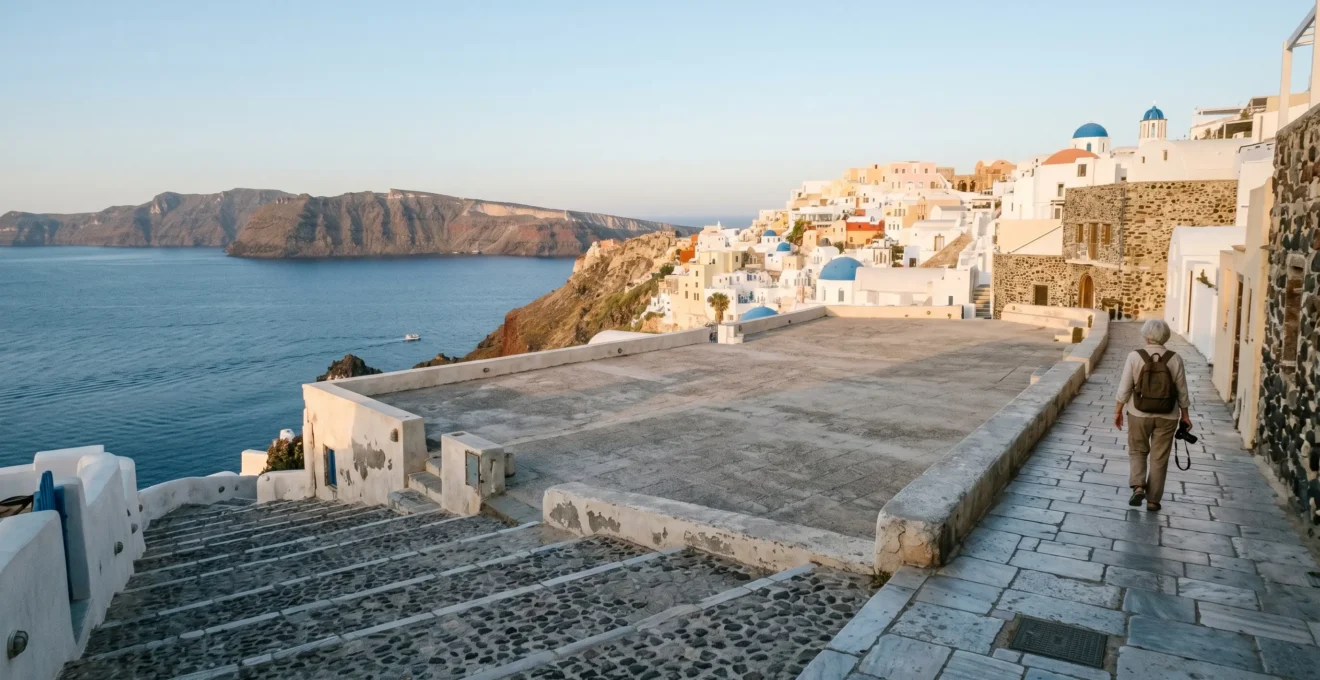
You picture yourself on a Greek island, whitewashed village behind you, Aegean Sea stretching to the horizon. Then reality intrudes: a wall of selfie sticks, overflowing restaurants, and prices that make your eyes water. For the discerning UK traveller, the dream of visiting the world’s most iconic destinations is often soured by the nightmare of overtourism. The common advice is to simply « travel in the shoulder season, » but this is a blunt instrument in a world of complex travel patterns. What if the real solution isn’t just picking a different month, but adopting an entirely new mindset?
The secret is to evolve from a mere tourist into a temporal strategist. This approach goes beyond basic off-peak booking. It’s about understanding the hidden rhythms of a destination, anticipating the flow of crowds, and identifying the precise micro-windows of opportunity that grant you a more authentic and enjoyable experience. It’s a calculated strategy, a blend of art and science that weighs the risk of unpredictable weather against the certainty of peak-season chaos. This isn’t about avoiding popular places; it’s about experiencing them as they were meant to be seen.
This guide provides the tactical playbook to do just that. We will deconstruct the when, why, and how of perfect travel timing, moving from broad seasonal choices to the specific day-of-the-week decisions that make all the difference. Prepare to transform your approach to travel planning, unlocking better experiences at a fraction of the cost and stress.
To help you navigate these strategies, this article breaks down the core components of becoming a master of travel timing. The following sections will guide you through a complete framework for planning your perfectly-timed escape.
Summary: The Art of Strategic Travel Timing
- Why Is the Greek Islands Experience 10x Better in May Than August?
- How to Avoid Fake Shoulder Seasons That Are Still Packed With Tourists?
- Shoulder Season Weather Gamble vs Peak Season Crowds: Which Risk Is Worth It?
- The Off-Season Trap Where Half the Restaurants and Sites Are Shut
- How Far in Advance Should You Book Shoulder Season Travel for Best Prices?
- The Weekend Visit Mistake That Ruins Historical Landmark Experience
- When Should You Avoid Destinations Suffering From Overtourism?
- How Can You Find Amazing Destinations Before Instagram Ruins Them?
Why Is the Greek Islands Experience 10x Better in May Than August?
The difference between visiting the Greek Islands in May versus August is not just a matter of degree; it’s a completely different holiday. August represents the peak of heat, crowds, and cost. Temperatures regularly soar between 28-36°C under a relentless sun, making daytime sightseeing a genuinely uncomfortable endurance test. More importantly, the entire tourist infrastructure is stretched to its breaking point. Locals on popular islands are often exhausted by months of relentless work, and the authentic charm you came for is buried under a layer of transactional tourism. Many Greeks themselves consider visiting the popular islands in August to be slightly gauche, a clear sign of a tourist out of sync with the local rhythm.
Contrast this with May. The landscape is still lush and green from the winter rains, a vibrant backdrop that the summer heat will soon parch. The sea has warmed up enough for swimming, but the air remains pleasant and fresh. Most importantly, the atmosphere is one of hopeful anticipation rather than weary exhaustion. You can get a table at a seaside taverna without booking days in advance, hike a coastal path and hear birds instead of chatter, and have genuine conversations with locals who are happy to see you. The experience is simply more authentic, more relaxed, and of a higher quality. While August delivers the holiday you see in over-saturated brochures, May delivers the Greece you read about in novels.
This isn’t just anecdotal. Tourism analysis consistently identifies April–May and September–October as the optimal months for visiting. By choosing these shoulder periods, you are not compromising; you are upgrading your entire experience from a crowded commodity to a personal discovery, all while paying significantly less for the privilege.
How to Avoid Fake Shoulder Seasons That Are Still Packed With Tourists?
You’ve cleverly booked a trip in early October, picturing quiet cobblestone streets, only to find your destination’s port clogged with three mega-cruise ships disgorging 10,000 people. This is the trap of the « fake shoulder season, » where crowd levels are artificially inflated by what a temporal strategist calls manufactured crowds. The primary culprit is the cruise industry, which can flood a small city for six hours, overwhelming landmarks and local services before disappearing, leaving you to wonder what happened to your quiet getaway.
Avoiding this requires a more granular level of planning. Your strategy must be to identify these scheduled tourist invasions and plan around them. The key is to check the port authority’s cruise schedule for your destination. Most ports publish a calendar 6-12 months in advance. A quick search for « [Your Destination] Port Cruise Schedule » will often yield a PDF or online calendar. Look for days with multiple large ships (over 3,000 passengers) docking simultaneously. These are the days to avoid the main town square or plan a trip to the countryside. For real-time data, tools like MarineTraffic or CruiseMapper allow you to see exactly which ships are in port or scheduled to arrive on any given day.
This proactive reconnaissance is the difference between a strategic traveller and a disappointed tourist. By identifying these manufactured crowd-bombs, you can treat them like a predictable weather event. On a « three-ship day, » you might explore a lesser-known neighbourhood, take a cooking class, or visit a museum in the late afternoon after the crowds have returned to their ships. You reclaim control over your experience, sidestepping the hordes while others are swept away by them. This isn’t about avoiding a month; it’s about sidestepping a specific Tuesday.
Shoulder Season Weather Gamble vs Peak Season Crowds: Which Risk Is Worth It?
Choosing when to travel is fundamentally a risk-reward calculus. Peak season (July-August) offers a low-risk guarantee of hot, sunny weather in destinations like the Mediterranean, but it comes with the 100% certain « risk » of extreme crowds, peak prices, and a strained travel experience. The shoulder season (May-June, September-October) reverses this equation: you accept a slightly higher risk of a few cloudy or rainy days in exchange for the massive reward of fewer people, lower costs, and a more authentic atmosphere. The question is, which risk is more detrimental to your holiday?
For the strategic traveller, the answer is almost always the peak season crowd. A day of intermittent rain in Florence in October is a minor inconvenience; you can still enjoy museums, savour a long lunch, and appreciate the city’s beauty. In contrast, a « perfectly » sunny day in August can mean spending three hours queuing for the Uffizi Gallery, barely being able to move on the Ponte Vecchio, and paying double for a hotel room. Bad weather is a possibility; overwhelming crowds are a certainty. Furthermore, European weather data shows that May and September are optimal months with predominantly clear, warm climates, making the « gamble » a very calculated and often successful one.
The best way to make this decision is to align it with your trip’s primary goal. Are you planning a fly-and-flop beach holiday where sunshine is non-negotiable? Or is it a city break focused on culture, food, and history? The following matrix can help you assess your own risk tolerance.
This risk matrix, inspired by an analysis from travel experts, helps clarify which gamble is right for you.
| Trip Primary Goal | Weather Risk Level | Shoulder Season Suitability | Recommendation |
|---|---|---|---|
| Beach Relaxation Vacation | High | Medium | Consider late May or early September when water is warm but weather more predictable |
| City Museum & Foodie Trip | Low | Excellent | Shoulder season ideal – indoor activities unaffected by weather variations |
| Mixed Hiking & Culture | Medium | Good | Prepare alternative indoor itinerary; mild temperatures better for active pursuits |
| Photography & Landscape | Low-Medium | Excellent | Variable weather creates dramatic lighting conditions and fewer crowds |
The Off-Season Trap Where Half the Restaurants and Sites Are Shut
There is a fine line between the vibrant « shoulder season » and the desolate « off-season. » Pushing your travel dates too far into late October or early April can land you in the off-season trap: a destination that is technically open but functionally a ghost town. You arrive to find that idyllic seaside restaurant is shuttered, the ferry to a nearby island runs only twice a week, and the general atmosphere is one of hibernation. You’ve avoided the crowds, but you’ve also avoided the very life and soul of the place you came to see.
Your mission as a temporal strategist is to gather intelligence to find the sweet spot. You need to look for authenticity signals that a place is winding down, not just quieting down. The single most powerful tool for this reconnaissance is Google Maps. Don’t just look at reviews; become a digital detective. Before booking, perform this simple check: identify 5-10 key restaurants, cafes, and attractions you’re interested in. Click on each one and scrutinize the « Hours » section. Look for notices like « Seasonal Hours, » « Temporarily Closed, » or reduced days of operation for your target month. If more than half the places on your list show signs of closure, that’s a major red flag.
This intelligence-gathering extends to transport. Check the official websites for local bus and ferry services. Do they publish a « Summer Schedule » and a « Winter Schedule »? If your dates fall under the winter schedule, you can expect significantly reduced services that could hamper your ability to explore. This simple audit separates a truly viable shoulder-season gem from a frustratingly dormant town. It ensures your reward for avoiding the crowds isn’t a lonely walk past closed doors.
Your 5-Step Authenticity Audit: Is Your Shoulder-Season Pick a Gem or a Ghost Town?
- Points of contact: List all channels where the destination’s « open for business » signal is emitted (e.g., official tourism sites, blogs, Google Maps listings).
- Collecte: Inventory existing evidence by checking the seasonal opening hours of 5-10 key restaurants, attractions, and transport links for your specific dates.
- Cohérence: Confront this data with your travel values. If you value spontaneous dining and easy exploration, do the limited hours and transport schedules align with that?
- Mémorabilité/émotion: Spot unique vs. generic signals. Is the one open restaurant a genuine local spot, or a generic tourist trap that stays open year-round? The quality of what remains open matters.
- Plan d’intégration: Based on your findings, create a realistic plan. If many places are closed, either adjust your dates or build a new itinerary around the confirmed openings.
How Far in Advance Should You Book Shoulder Season Travel for Best Prices?
Booking for the shoulder season isn’t just about choosing the right dates; it’s about booking at the right time. The pricing dynamics are different from peak season, and a smart booking strategy can lead to substantial savings. The goal is to hit the sweet spot where flight prices have dipped but the best-value accommodation hasn’t been snapped up yet. As a rule of thumb, the savings are significant; fare tracking data reveals flights run 25-40% below peak July prices in May and September, with hotels often 30-50% cheaper.
However, a one-size-fits-all « book X months in advance » rule doesn’t work. A temporal strategist uses a tiered approach, booking different components of their trip in different time windows. International flights, for instance, often have the most stable and predictable pricing curves. In contrast, unique accommodations with limited inventory require a much earlier booking, while a traveller can afford to be more opportunistic with standard hotels or car rentals.
This tiered strategy gives you the best of both worlds: you lock in the major, price-sensitive components early, while retaining flexibility on others to capitalize on later deals. It’s about playing the odds correctly for each part of your trip. The following timeline provides a practical framework for this approach.
This strategic timeline, based on an analysis of shoulder season booking patterns, provides a clear roadmap.
| Booking Category | Optimal Advance Window | Reasoning | Flexibility Strategy |
|---|---|---|---|
| International Flights | 3-6 months | Supply/demand curves stabilize in this window for shoulder periods | Set price alerts; book when 25%+ below peak prices |
| Unique/Boutique Accommodations | 6-9 months | Limited inventory books fast even in shoulder season | Book refundable rates when possible |
| Standard Hotels & Tours | 1-3 months | Last-minute deals often appear as operators fill capacity | Monitor weekly; flexibility yields best savings |
| Car Rentals (Europe) | 1-2 months | Booking too early can be expensive; prices often drop closer to dates | Book with free cancellation; re-check prices monthly |
The Weekend Visit Mistake That Ruins Historical Landmark Experience
You’ve successfully chosen a shoulder season month and dodged the cruise ships, but you can still ruin your experience at a world-famous landmark like the Louvre or the Colosseum with one simple mistake: visiting on a Saturday. Weekend crowds, even in the shoulder season, are a completely different beast. They are composed of other tourists on short city breaks and, crucially, local residents enjoying their time off. This creates a perfect storm of congestion that can turn a visit into a shuffling, frustrating ordeal.
The strategic traveller knows that the day of the week is as important as the month of the year. The absolute golden window for visiting major landmarks is often Tuesday morning, right at opening time. The weekend crowds are long gone, Monday has been used by the institution for catch-up and administration, and the mid-week rush has yet to begin. This is your micro-window of opportunity. By arriving 15 minutes before the doors open on a Tuesday, you can often enjoy the most famous exhibits in relative peace before the tour groups arrive.
To elevate this strategy, apply these tactical manoeuvres:
- Reverse Traversal: If the layout allows, enter the landmark and walk directly to the furthest point, then work your way back. You’ll be moving against the natural flow of human traffic.
- Go for the Jugular: Head immediately to the single most famous exhibit (the Mona Lisa, the Crown Jewels) while everyone else is starting at the beginning of the prescribed route. You can explore the rest later when it’s busier.
- The Lunch-Hour Lull: The period between 12:30 PM and 2:00 PM often sees a dip in crowds as large tour groups are herded to their designated lunch spots.
- The Closing-Time Clear-Out: Arrive 90-120 minutes before closing. You’ll witness the landmark progressively empty, often granting you a nearly private viewing in the final half-hour.
- The School Group Dodge: Always check the landmark’s « Education » or « School Visits » section on their website. This can help you avoid weekday mornings when hundreds of children might be present.
When Should You Avoid Destinations Suffering From Overtourism?
Sometimes, even the most sophisticated timing strategies are not enough. Certain destinations have reached a saturation point where the tourist-to-resident ratio is so skewed that the authentic experience is permanently compromised. These are places suffering from chronic overtourism. As a responsible and strategic traveller, the best move is sometimes to simply not go, especially during any period remotely close to the high season. Identifying these locations is a crucial part of your planning process.
Hallmarks of an overtouristed destination include the implementation of tourist taxes, restrictions on visitor numbers, and vocal protests from a resident population pushed to its limits. Venice is a prime example. In 2024, it faced daily tourist numbers of 80,000, leading the city to introduce a tourist tax to manage the flow. Similarly, on the Greek island of Santorini, European Commission studies document a staggering ratio of 220 tourists for every resident annually. When the infrastructure is this overwhelmed, your presence, no matter how well-intentioned, contributes to the problem.
Case Study: Venice’s Battle Against Overtourism
The city of Venice provides a stark lesson in the impacts of overtourism. As detailed in reports on global tourism hotspots, the city’s fragile ecosystem is under immense strain. With an average of 80,000 daily visitors in 2024, the local population is shrinking as authentic life is eroded. In response, a tourist tax was introduced, raising €2.4 million in its first year but doing little to stem the tide, as 60-70% of visitors are day-trippers who contribute little to the local economy while straining its resources. For travellers, this means crowded vaporettos, inflated prices, and the sense of being on a theme park conveyor belt, not in a living city.
The strategic choice here is twofold. First, if you absolutely must visit these hotspots, do so in the absolute depths of the off-season (e.g., Venice in February) and plan to stay for several nights to contribute more meaningfully to the local economy. Second, and more powerfully, is to apply the « second city » strategy. Instead of Venice, consider Trieste or Bologna. Instead of Barcelona, explore Valencia or Seville. These places often offer a more authentic, enjoyable, and sustainable travel experience.
Key Takeaways
- Mastering timing is more than choosing a season; it requires understanding the specific day and hour to find « micro-windows » of opportunity.
- Proactively research and plan around « manufactured crowds, » such as those from cruise ships or tour buses, to avoid fake shoulder seasons.
- A tiered booking strategy is essential: book flights and unique lodging early (3-9 months), but retain flexibility for hotels and car rentals to catch later deals (1-3 months).
How Can You Find Amazing Destinations Before Instagram Ruins Them?
The ultimate move for a temporal strategist is not just to visit popular places at the right time, but to discover incredible destinations before they become popular in the first place. In an age of social media, destinations can go from hidden gems to over-run hotspots in a single season. Staying ahead of this curve requires a shift from consuming travel content to actively seeking out patterns and signals that point to the « next big thing. » This is the final frontier of crowd-avoidance: spatial, not just temporal, strategy.
The first step is to change your sources of inspiration. Move away from mainstream travel influencers and Instagram feeds, which are lagging indicators of popularity. Instead, cultivate a more niche set of sources. Follow food writers, architects, or historians; their travels are dictated by their craft, not by trending locations. Read old-school guidebooks from a decade ago and see which « up-and-coming » places they mentioned that never quite took off. This is often where true authenticity lies.
Another powerful technique is the « Second City » strategy on a larger scale. Look at a map. Where do the budget airlines fly to that isn’t a major capital? These secondary airports are gateways to regions that are often just as beautiful but lack the marketing machine of their famous neighbours. Think Puglia instead of Tuscany, or the Costa de la Luz instead of the Costa del Sol. Use Google Maps in satellite mode and trace a coastline away from a major resort. What are the names of the small villages you see? This kind of map-led discovery, combined with a willingness to embrace the unknown, is the most effective way to find your own slice of paradise, long before the rest of the world gets the memo.
Now that you have the complete playbook, the next step is to apply these temporal strategies to your own travel aspirations. Start by re-evaluating a destination on your list through this new lens of timing, manufactured crowds, and authenticity signals.