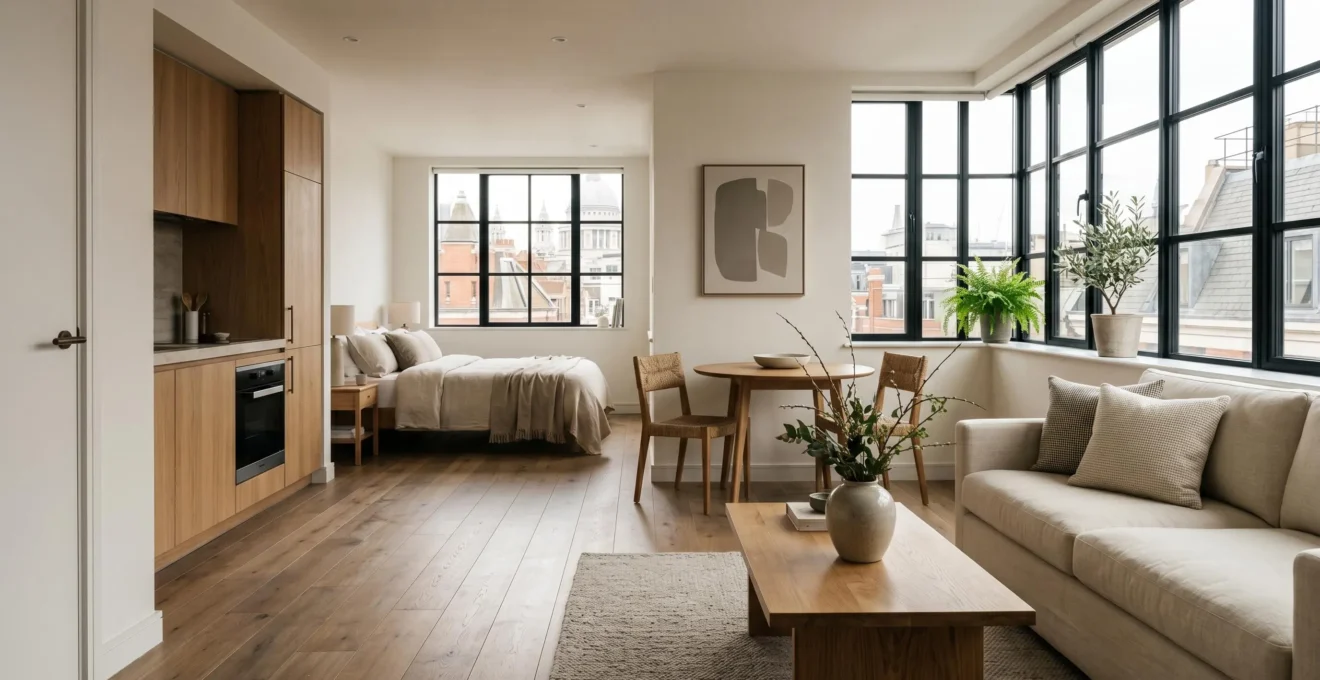
Making a small London flat feel genuinely spacious isn’t about visual tricks like mirrors or white paint. The true solution lies in understanding the psychology of space. By designing for « perceived space »—how your brain interprets an environment—and focusing on functional flow, you can reduce cognitive load and create a home that is not only comfortable but feels significantly larger and more supportive of your daily life.
Living in a compact London flat often feels like a constant compromise. You pay a premium for location, but the price is paid again daily in a frustrating lack of space, where your living room is also your office and your dining area is a negotiation with the sofa. The internet is flooded with simplistic advice: add mirrors, paint everything white, and declutter relentlessly. While well-intentioned, these tips only scratch the surface, often leading to sterile environments that look good in a photo but lack soul and functionality.
These solutions treat the symptoms, not the cause. They focus on creating a visual illusion of space, a fragile trick easily broken by the reality of daily life. But what if the key wasn’t about making a space *look* bigger, but about making it *feel* bigger and work smarter? The true shift happens when you stop fighting the square meterage and start designing for psychological comfort and functional flow. This is the difference between a cramped box and a well-designed sanctuary.
This guide moves beyond the platitudes to explore the principles of perceived space. We will delve into how your brain processes your environment, how to create multi-functional zones that don’t feel chaotic, and how to use storage as a strategic tool for calm rather than a source of clutter. By the end, you’ll have a new framework for transforming your small flat into a home that is both truly comfortable and genuinely spacious.
To navigate this new perspective on small-space living, this article breaks down the core concepts that empower you to reclaim your home. The following sections offer a structured journey from understanding the theory to applying it in practice.
Summary: A Practical Guide to Designing for Perceived Space in Compact Homes
- Why Do Some 40m² Flats Feel Bigger Than 60m² Apartments?
- How to Fit Bedroom, Office, and Living Room in One Small Space?
- Minimalism vs Maximalism in Small Spaces: Which Creates More Liveable Homes?
- The Storage Solution Trap That Makes Small Spaces Feel Even Smaller
- When Is Your Home Too Small and You Need to Move?
- Why Does a Messy Home Make You Feel Anxious Even When Relaxing?
- How to Evaluate Your Life Balance in 10 Minutes Without Overwhelm?
- How Can You Design Your Home to Feel Like a Sanctuary Not a Stress Source?
Why Do Some 40m² Flats Feel Bigger Than 60m² Apartments?
The answer has less to do with tape measures and more to do with neuroscience. The experience of space is not a direct reading of physical dimensions but a psychological construction. A space « feels » big or small based on how our brain processes the visual information it receives. The key factor is cognitive load—the amount of mental effort required to make sense of an environment. A cluttered, chaotic space forces your brain to work overtime, creating a feeling of being closed-in and stressed, regardless of the actual size.
Scientific research backs this up. According to insights from a Princeton University Neuroscience Institute study, physical clutter overloads your visual cortex, making it harder to focus and process information. Every object competes for your attention. In contrast, a space with clear pathways, defined zones, and managed visual « noise » allows the brain to process the environment effortlessly. This creates a sense of calm, order, and what we perceive as spaciousness.
This is why a well-designed 40m² flat with a clear functional flow and intentional decor can feel more expansive than a poorly laid-out 60m² apartment filled with visual distractions. The « spacious » feeling comes from visual simplicity and functional clarity, not just from empty floor space. It’s about curating what you see so your brain doesn’t have to work so hard, allowing it to relax into the space you have.
Ultimately, designing for perceived space means becoming an editor of your own environment, prioritising mental peace over sheer quantity of possessions.
How to Fit Bedroom, Office, and Living Room in One Small Space?
The challenge of creating a multi-functional home is a growing reality, especially in urban centres like London. With modern living spaces shrinking, the single-purpose room is a luxury many can’t afford. Indeed, apartments today are often 100 square feet smaller than those built just two decades ago. The solution isn’t to cram three rooms’ worth of furniture into one, but to design for « temporal zoning » and « functional flow. » This means creating a space that seamlessly transitions between activities throughout the day.
Instead of thinking in terms of physical walls, think in terms of psychological thresholds. These are subtle cues that signal a shift in function. A change in lighting (a desk lamp for work, a floor lamp for relaxing), a different rug texture, or even the act of folding away a piece of furniture can mentally separate your « office » from your « living room. » This approach allows a single area to serve multiple purposes without feeling chaotic.
As the image demonstrates, the key is transformable and adaptable design. A Murphy bed can fold away to reveal a desk, a dining table can double as a collaborative workspace, and a modular sofa can be reconfigured for guests or a quiet evening. The goal is to create a dynamic environment where the furniture and layout support the activity of the moment, ensuring clear floor space and a sense of order are maintained at all times. This is how you achieve a bedroom, office, and living room in one cohesive and comfortable space.
This thoughtful approach transforms a small flat from a container of things into a highly efficient and supportive partner in your daily life.
Minimalism vs Maximalism in Small Spaces: Which Creates More Liveable Homes?
The default advice for small spaces is invariably « go minimalist. » While minimalism’s focus on clean lines and uncluttered surfaces is an effective way to reduce cognitive load, it’s not the only path to a liveable home. The debate between minimalism and maximalism is less about a « right » aesthetic and more about aligning your environment with your personality. A home becomes liveable when it feels like an authentic expression of who you are.
For some, the serene, ordered environment of minimalism is a necessary antidote to a chaotic world. As one academic analysis notes, « Minimalist spaces are associated with feelings of calmness, focus, and mindfulness, promoting a sense of clarity and order. » It prioritises « breathing room » and allows each chosen object to have a significant impact. It is a philosophy of intentional reduction, where spaciousness is achieved by curating only the most essential and beautiful items.
However, for others, a sterile, minimalist space can feel impersonal and cold. Maximalism, when done well, is not about hoarding; it’s about curated abundance. It uses layers of texture, colour, art, and personal objects to tell a story and create a rich, enveloping environment. A maximalist home can serve as an « emotional refuge and a source of identity, » where being surrounded by beloved books, travel souvenirs, and meaningful art fosters a sense of comfort and belonging. In a small space, this means using walls for gallery displays, embracing rich textiles, and ensuring every item is part of a cohesive personal narrative.
The most liveable small home is not one that follows a trend, but one that is a deliberate and joyful reflection of its inhabitant’s inner world.
The Storage Solution Trap That Makes Small Spaces Feel Even Smaller
In the quest to conquer clutter, many fall into the « storage solution trap »: filling a small flat with bulky, opaque storage units. We buy chunky chests of drawers, solid wardrobes, and dark bookcases, believing we are creating order. In reality, we are often just building walls within our walls. These solid, floor-to-ceiling objects eat up precious floor space, block light, and create heavy visual barriers, making the room feel even more cramped and fragmented than the original clutter did.
The mistake is thinking about storage as a way to hide things. A more effective strategy is to think of it as integrated architecture. The goal is not just to contain items, but to do so while preserving, or even enhancing, the perception of space. This involves using solutions that are vertical, peripheral, and visually lightweight.
Case Study: The Tokyo Peripheral Storage Strategy
Designs featured in publications like Never Too Small often showcase this principle in action. In one Tokyo apartment, for example, designers avoided bulky floor units entirely. Instead, they ran high, open shelving along the perimeter of the room, close to the ceiling. This draws the eye upward, creating a sensation of height. By using suspended wire shelves and other « floating » solutions, they provided significant storage capacity without sacrificing floor-level openness or visual continuity. The transparency of the materials ensures that sightlines remain unbroken, which is critical for maintaining a feeling of spaciousness.
This approach works because it keeps the main living area—the central volume of the room—clear and open. Storage is pushed to the edges and up the walls, becoming part of the room’s architecture rather than an obstacle within it. Using materials like glass, metal mesh, or even just painting shelves the same colour as the wall helps them recede visually, further reducing their impact on the perceived space.
By rethinking storage, you can declutter your flat without making it feel like a warehouse.
When Is Your Home Too Small and You Need to Move?
This is a deeply personal and often emotional question for anyone living in a compact space. It’s easy to get caught up in external benchmarks. For example, some data shows that the average living space per capita in Germany was 47.7 square meters in 2021. Comparing your 35m² London flat to such a number can easily trigger feelings of inadequacy. However, these objective figures are a distraction. The true measure of whether your home is « too small » is not its square meterage, but its functional capacity.
A home is too small when it consistently fails to support your core life functions and actively creates friction in your daily routines. It’s not about the lack of a guest room; it’s about not having a stable, comfortable place to do your work. It’s not about a small kitchen; it’s about a kitchen so poorly designed that cooking a healthy meal becomes a stressful ordeal you avoid. The breaking point is reached when your environment is no longer a supportive base but a constant source of compromise and frustration.
The critical signs to watch for are not about size, but about function:
- Chronic Discomfort: You can’t find a comfortable position to work, relax, or sleep without constant adjustment.
- Activity Avoidance: You stop inviting friends over, pursuing a hobby, or even cooking because the logistics in your space are too difficult.
- Persistent Stress: You feel a low-level anxiety or irritation at home, even when it’s tidy, because the space is fundamentally at odds with your needs.
When you’ve exhausted every design trick and optimisation strategy, and your home still actively hinders your well-being and life goals, then it is no longer a question of design. It’s a clear signal that it’s time to move.
Why Does a Messy Home Make You Feel Anxious Even When Relaxing?
That feeling of unease you get from a messy room, even when you’re trying to relax, isn’t just in your head—it’s in your biology. A cluttered environment acts as a low-grade, chronic stressor. Research has clearly shown there are spikes in cortisol, the body’s primary stress hormone, related to clutter in the home. Your body is reacting to the visual chaos with a physiological fight-or-flight response, making true relaxation impossible.
The psychological mechanism behind this is rooted in cognitive load. A tidy, ordered space is easy for your brain to process, freeing up mental resources. A messy space, however, is a minefield of unfinished business. As neuroscience research summaries from outlets like Brooklyn Psychotherapy explain, every out-of-place item is an unprocessed decision that taxes your prefrontal cortex.
Every out-of-place item is an unprocessed decision that taxes the prefrontal cortex, leaving fewer mental resources for true relaxation or deep focus.
– Brooklyn Psychotherapy, Analysis of cognitive load and environmental psychology
That pile of mail isn’t just paper; it’s a stack of decisions to be made. The clothes on the chair aren’t just fabric; they represent the tasks of « put away, » « wash, » or « mend. » Your brain can’t fully switch off because it’s constantly being pinged by this visual to-do list. This continuous, low-level demand on your executive function is exhausting. It’s why you can feel drained after a day in a messy house without having done anything physically strenuous. You are fighting a constant, invisible battle against decision fatigue.
Creating a calm environment is therefore not an act of shallow tidiness, but a profound act of self-care, designed to protect your most valuable resource: your mental energy.
How to Evaluate Your Life Balance in 10 Minutes Without Overwhelm?
Evaluating your home’s effectiveness can feel like an overwhelming task, often leading to paralysis. To cut through the noise, you need a simple, targeted diagnostic tool. Instead of trying to fix everything at once, the goal is to identify the single most significant point of friction in your space. The « Wheel of Home » framework is a quick, visual method to do just that, allowing you to assess how well your current environment supports your life, not just how it looks.
This 10-minute exercise moves you from a vague feeling of « this isn’t working » to a specific, actionable insight. It’s not about achieving a perfect score in all areas; it’s about identifying the one « weakest link » that, if improved, would have the most significant positive impact on your daily experience. By focusing your energy on the lowest-scoring function, you ensure your efforts are directed where they matter most, creating tangible improvements rather than getting lost in an endless cycle of minor tweaks.
Your 10-Minute Home Function Audit
- Core Functions: Identify your six essential home activities (e.g., Work, Sleep, Socialising, Hobbies, Cooking, Health/Movement).
- Rate Your Space: For each function, rate how well your current home supports it on a scale of 1 (constant frustration) to 10 (perfectly optimised).
- Visualise the Gaps: Imagine the scores as spokes on a wheel. A balanced life is a round wheel. Where is yours flat?
- Pinpoint the Weakness: Identify the function with the lowest score. This is your priority target for improvement.
- Create One Action: Define a single, concrete goal to improve that specific function (e.g., if ‘Work’ scores a 2 due to poor lighting, the action is « buy and install a dedicated desk lamp »).
This structured approach prevents overwhelm by transforming a complex problem into a single, manageable task. It gives you a clear starting point for making meaningful changes that will directly enhance your quality of life within your existing space.
By regularly performing this check-up, you can ensure your home evolves with your needs, remaining a supportive sanctuary rather than a source of stress.
Key takeaways
- Your brain’s perception of space is more important than actual square meterage; reduce cognitive load to feel more spacious.
- Design for functional flow and temporal zoning, not for static, single-purpose rooms.
- Both minimalism and maximalism can work in small spaces if they are an intentional and curated reflection of your identity.
How Can You Design Your Home to Feel Like a Sanctuary Not a Stress Source?
Transforming a home from a source of stress into a sanctuary is the ultimate goal of interior design, especially in a compact flat. This final step is about synthesis—weaving together the principles of psychological comfort, functional flow, and personal expression. A sanctuary is not created by following a checklist of trends, but by making a series of highly intentional choices that align your physical environment with your inner needs.
It begins by accepting that your home’s primary job is to support you. This means actively designing spaces for rituals of calm, whether that’s a comfortable armchair with good light for reading, a dedicated corner for morning coffee, or a clear surface for creative pursuits. As design analyses from outlets like ArchDaily suggest, this can be achieved through different aesthetic lenses. « Maximalist interiors often display artifacts…that reflect personal history…fostering social interaction, » while « minimalist design brings calm, clarity, and focus. » The key is intentionality.
A true sanctuary also engages more than just the sense of sight. It involves layering textures that feel good to the touch (soft wool, cool linen, smooth wood), incorporating natural elements like plants to improve air quality and provide a connection to nature (biophilic design), and controlling light to match your mood and energy levels. It’s about creating an environment that calms your nervous system on a subconscious level, a space where your brain can finally stop processing and just be.
Start by using the « Wheel of Home » audit to identify your biggest point of friction, and commit to resolving that one issue. This single, focused action is the first step in the powerful process of designing a home that actively nurtures your well-being.