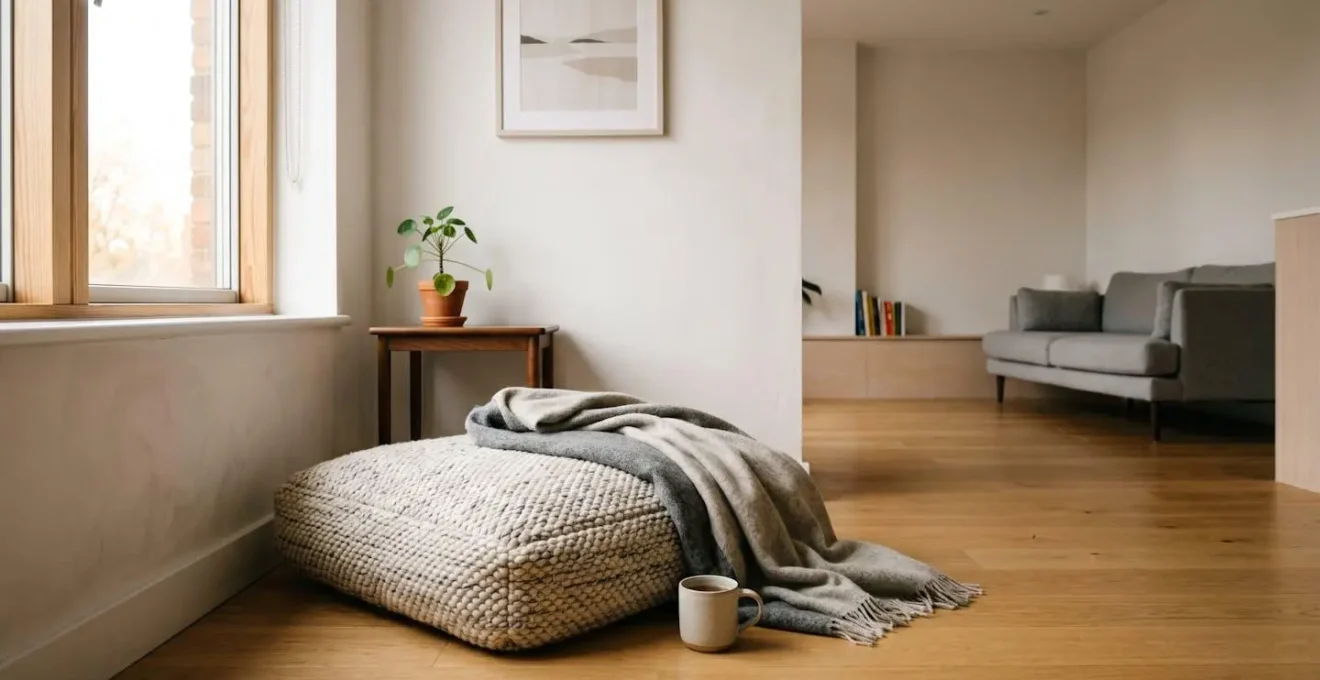
The key to creating a true personal refuge isn’t about physical barriers like screens, but about engineering a sensory toolkit that actively calms your nervous system.
- Your need for personal territory is a biological imperative for self-regulation, not a rejection of your loved ones.
- A successful refuge is defined by its function—how it makes you feel—not its aesthetics. It must be a space for intentional recharging, not just hiding from life.
Recommendation: Start by identifying one sensory anchor (a specific scent, texture, or sound) and a ‘threshold ritual’ to signal to your brain it’s time to decompress, turning any corner into a functional sanctuary.
Living in a shared home, whether with a partner, family, or housemates, presents a modern paradox: you can be surrounded by love and companionship, yet feel a desperate, almost primal need for a space to call your own. There’s a particular kind of exhaustion that comes from being constantly available, a low-grade sensory friction that erodes your mental reserves. You feel ‘touched out’, perpetually observed, with no corner of your own home offering a true psychological exhale.
The common advice often feels flimsy and inadequate. You’re told to buy a room divider, put on noise-cancelling headphones, or simply « talk it out ». While well-intentioned, these solutions treat the symptom—a lack of physical privacy—while ignoring the root cause: the nervous system’s profound need for a predictable, controllable sanctuary to down-regulate and restore itself. The constant negotiation for space and quiet becomes another task on an already overflowing mental to-do list.
But what if the solution wasn’t about building higher walls, but about understanding the deeper mechanics of personal space? What if the key to carving out a refuge wasn’t in interior design, but in neuroscience? This guide moves beyond the platitudes of cushions and candles. It reframes the concept of a personal refuge from a decorated corner into a functional, precisely engineered tool for mental and emotional restoration. It’s about creating psychological territory, even in the smallest of physical footprints.
We will explore why this need is a biological necessity, how to build a functional sanctuary in a shared room, distinguish between healthy refuge and unhealthy hiding, and finally, how to reclaim the time and set the boundaries needed to make it all work. This is your blueprint for building an internal and external sanctuary that allows you to show up as a better partner, parent, and person.
This article provides a comprehensive framework for understanding and creating your personal refuge. The following sections will guide you through each critical step, from the foundational psychology to the practical, daily techniques.
Contents: Carving Out Your Personal Sanctuary in a Shared Home
- Why Do You Need Personal Territory Even in Loving Relationships?
- How to Create Mental Refuge in a Bedroom Corner or Shared Living Room?
- Spare Room Sanctuary vs Portable Refuge Kit: Which Serves Modern Lives Better?
- The Refuge Trap of Hiding From Life Instead of Recharging for It
- When Does Constant Sanctuary-Seeking Mean You Should Change Your Life?
- How to Calm Your Nervous System in Under 5 Minutes During Work Chaos?
- How Much Personal Time Do You Actually Need to Prevent Burnout?
- How Can You Reclaim Personal Time in an Always-On Work Culture?
Why Do You Need Personal Territory Even in Loving Relationships?
The guilt-tinged question, « Is it normal to need space from the people I love? » is one many ask in silence. The answer is an unequivocal yes. This desire isn’t a sign of a failing relationship or a personal flaw; it’s a deep-seated biological and psychological imperative. Far from being a rejection, carving out personal territory is a prerequisite for maintaining a healthy self, which in turn allows you to engage more fully and generously with others. Your brain is wired to need a zone of safety and predictability that is exclusively yours.
Science gives this a name: peripersonal space. This isn’t just the physical bubble around you; it’s a complex neural construct. As researchers from the National Center for Biotechnology Information explain, it is the crucial area « where most of the interactions between the subject and the environment, including other individuals, take place. » This space is constantly being monitored by your brain for threats and opportunities. In a shared home, this monitoring system is always active, leading to a state of low-level, chronic hypervigilance. Having a personal territory allows that system to finally stand down, conserving immense mental energy.
Peripersonal space is a construct referring to the portion of space immediately surrounding our bodies, where most of the interactions between the subject and the environment, including other individuals, take place.
– National Center for Biotechnology Information Research Team, Neuroanatomical correlates of peripersonal space study
This need transcends culture. A 2024 global study involving 650,000 individuals from 196 countries confirmed that while the exact dimensions of personal space vary, the fundamental need for it is universal. Within a loving home, your personal territory becomes a space not for isolating yourself, but for self-regulation. It’s where you process the day’s stimuli, reconnect with your own thoughts and feelings, and reset your nervous system. Without this dedicated zone, you are forced to process life « in public, » which is as inefficient as it is draining. A personal refuge is the physical anchor for the mental process of returning to yourself.
How to Create Mental Refuge in a Bedroom Corner or Shared Living Room?
Creating a sanctuary in a shared space is not an act of interior design; it is an act of psychological engineering. The goal isn’t to create a corner that *looks* peaceful, but one that is functionally designed to calm your specific nervous system. This means moving beyond aesthetics and building a sensory toolkit—a curated collection of items and rituals that provide predictable, calming input to your brain. It starts with defining its purpose: is this for meditation, reading, or simply a 5-minute silent decompression? Clarity of purpose dictates the tools you need.
The core of this approach is conscious sensory anchoring. Instead of random cushions, choose a weighted blanket if pressure calms you. Instead of any candle, find a specific scent (like lavender or sandalwood) that you use *only* in this space. This creates a powerful Pavlovian response. The most critical element, however, is the threshold. You must create a conscious ‘threshold ritual’ to signal to your brain that you are transitioning into refuge mode. This could be as simple as putting on specific socks, playing a single ambient track, or taking three intentional breaths as you sit down. This ritual is the key that unlocks the sanctuary.
Lighting is your most powerful tool for creating a psychological boundary. A directional floor lamp can create a « pool » of light that acts as a temporary, invisible wall. When you are inside that pool of light, you are in your refuge. When it’s off, the space reverts to its shared function. Combine this with modular elements like a floor cushion that can be put away or a roll-up screen. The power of these elements lies in their temporary nature; they allow you to claim territory without permanently altering the shared landscape, respecting both your needs and the needs of those you live with. The final test is simple: trust your nervous system. If you don’t feel a measurable sense of calm after a few minutes, adjust your sensory inputs until you do.
Spare Room Sanctuary vs Portable Refuge Kit: Which Serves Modern Lives Better?
The ideal of a dedicated « room of one’s own » feels like a distant luxury for many. While a spare room transformed into a full sanctuary is the gold standard for deep restoration, its inflexibility and space requirement make it impractical for most. The modern, often chaotic, reality of shared living and hybrid work demands a more adaptable solution. This has given rise to the concept of the Portable Refuge Kit, a small, curated collection of items that provides immediate emotional first-aid. The question is not which is better, but which serves your immediate need.
A tiered system helps clarify their distinct roles. The Portable Kit is Tier 1: reactive, immediate, and designed for crisis management. It’s the headphones, the essential oil roller, and the smooth stone you keep in your desk drawer or handbag to manage a sudden spike of overwhelm. The Refuge Corner is Tier 2: designed for daily, proactive decompression. The Spare Room Sanctuary is Tier 3: a space for deep-dive restoration and proactive, scheduled retreats. The most resilient individuals don’t choose one; they build a system that incorporates elements of all three, using the right tool for the level of need.
The table below breaks down this tiered approach, helping you assess which level of refuge is most appropriate for different situations. As a recent comparative analysis of home sanctuary strategies highlights, the ultimate goal is not a perfect space, but a functional system.
| Refuge Type | Primary Function | Time Investment | Space Requirement | Best For | Limitations |
|---|---|---|---|---|---|
| Tier 1: Portable Refuge Kit | Immediate emotional first aid | 5-15 minutes | Fits in bag/drawer | Reactive crisis management, commuters, office workers | Limited depth of restoration, requires behavioral conditioning |
| Tier 2: Refuge Corner | Daily decompression | 30-60 minutes | Small corner or nook | Regular self-regulation, shared living spaces | May lack privacy in very crowded homes |
| Tier 3: Spare Room Sanctuary | Deep-dive restoration | 1-3 hours | Dedicated room | Proactive scheduled restoration, intensive creative work | Requires significant space, may foster avoidance if misused |
Ultimately, the Portable Refuge Kit often serves modern lives better because of its versatility. It acknowledges that stress and the need for regulation don’t happen on a schedule or only within the four walls of your home. By learning to create micro-moments of sanctuary wherever you are, you build a far more robust and practical system for self-care than one that relies on a single, fixed location.
The Refuge Trap of Hiding From Life Instead of Recharging for It
There is a fine, but critical, line between using a sanctuary to recharge for life and using it to hide from life. A healthy refuge is a charging station; you plug in, replenish your energy, and then re-engage with the world, better equipped to handle its challenges. An unhealthy refuge becomes a bunker, a place of avoidance where problems are deferred, not processed. Falling into this « refuge trap » is a significant risk, especially when the world outside your sanctuary feels overwhelming or hostile.
The litmus test is the « re-entry. » Do you emerge from your refuge feeling restored, with greater clarity and capacity to face your responsibilities? Or do you emerge with the same underlying anxiety, now compounded by the dread of having to finally deal with what you were avoiding? If it’s the latter, your sanctuary has become a tool for procrastination, not restoration. True solitude is chosen and empowering; isolation is fear-based and depleting. Your personal space should foster the former and guard against the latter.
Case Study: The Lockdown Litmus Test
During the 2020 pandemic lockdown, this distinction became starkly clear. A documented case involving a student in a house of nine revealed the dynamic perfectly. All residents sought refuge in their rooms from the chaos of shared living. However, a key difference emerged. Those who used their time alone to process emotions and then strategically re-engaged with housemates to solve conflicts maintained their mental well-being. In contrast, those who used their rooms to indefinitely avoid difficult conversations or household chores reported spiralling anxiety. This real-world scenario proves the refuge’s value is in its function as a temporary recharge station, not a permanent escape pod. The goal is to build resilience, not a thicker wall.
To avoid the trap, practice mindful re-entry. Before you leave your sanctuary, take a moment to name one specific action you feel more capable of taking now that you’ve recharged. It could be having a difficult conversation, tackling a dreaded task, or simply being more present with your family. This small, intentional act reframes the purpose of your refuge from an escape hatch to a launchpad.
When Does Constant Sanctuary-Seeking Mean You Should Change Your Life?
A personal refuge is a vital tool for managing the inevitable stresses of modern life. But when the need for that refuge becomes constant, insatiable, and the primary source of your well-being, it’s time to ask a harder question: are you trying to fix a sustainable problem with a temporary tool? Constant sanctuary-seeking can be a powerful diagnostic signal that the fundamental structures of your life—your job, your relationship, your living situation—may be the real issue. Your refuge has become a bandage on a wound that requires stitches.
The key is to observe the trend. Is the time you need in your refuge constantly increasing just to feel « normal »? Does the thought of a day without access to it induce genuine panic? If your sanctuary is the *only* place you feel you can be your authentic self, it’s a red flag. The refuge should build your resilience for the outside world, not highlight how intolerable that world has become. This is particularly true in the context of work. Research published in a peer-reviewed burnout syndrome study reveals that workplace stress is associated with 120,000 deaths and up to $190 billion in healthcare costs annually in the US alone, demonstrating the high stakes of ignoring chronic stress.
To determine if you’re in this danger zone, ask yourself some honest questions. Does emerging from your refuge leave you feeling more capable, or simply more anxious about returning to the fray? True recharging provides capacity; hiding just postpones the inevitable. If you consistently exit feeling dread, it indicates your life’s demands are chronically overwhelming your restorative capacity. No sanctuary, no matter how well-designed, can compensate for a life that is fundamentally misaligned with your values or needs. At that point, the most loving act of self-care isn’t to perfect your refuge, but to start planning how to change the life that makes it so necessary.
How to Calm Your Nervous System in Under 5 Minutes During Work Chaos?
The most effective refuge is the one you can access anywhere, anytime—especially during a moment of acute chaos at work when a physical sanctuary is out of reach. The key is to have a « portable refuge kit » of techniques that directly regulate your autonomic nervous system. These are not about positive thinking; they are physiological interventions that send a powerful « all clear » signal to your brain’s stress-response centre, the amygdala. The most potent of these requires nothing but your breath.
According to a landmark Stanford Medicine trial, one specific breathing technique outperforms others for immediate anxiety reduction. As lead researchers Andrew Huberman and David Spiegel concluded in their randomized controlled trial published in Cell Reports Medicine, « Physiological sighing came out on top as the most effective practice for reducing anxiety. » This technique involves a double inhale followed by a long exhale, which offloads carbon dioxide and mechanically re-inflates collapsed air sacs in the lungs, instantly calming the body.
When you feel that familiar spike of overwhelm—a stressful email, a difficult meeting—having a pre-rehearsed, 2-minute drill can be a lifesaver. These techniques pull your brain out of a looping anxiety spiral and ground it in the physical present. The goal is not to eliminate the stressor, but to manage your physiological response to it, allowing you to think clearly and act intentionally rather than reactively. Mastering one or two of these is like having an emergency brake for your nervous system.
Your 5-Point Emotional First-Aid Audit
- Technique Inventory: List every « in the moment » calming technique you currently use (e.g., deep breaths, walking away, checking phone). Be honest.
- Effectiveness Check: For each technique, rate its actual effectiveness on a scale of 1-5. Does it truly calm you, or just distract you?
- Sensory Gaps: Review the 5-4-3-2-1 technique. Which sense (sight, sound, touch, smell, taste) is most neglected in your current toolkit?
- Accessibility Audit: Can you perform your go-to technique silently at your desk without anyone noticing? If not, you need a more discreet option like the Physiological Sigh.
- Integration Plan: Choose ONE new technique from the list above. Practice it twice a day for a week when you are *not* stressed to build the neural pathway.
How Much Personal Time Do You Actually Need to Prevent Burnout?
The question of « how much » personal time is a trap; it implies a universal, fixed number. The reality is that the amount of restorative time you need is not a static figure but a dynamic variable, directly proportional to the energy-draining demands of your life. A more useful concept is the Minimum Effective Dose (MED): the smallest amount of high-quality, intentional personal time required to offset your specific daily stressors and prevent burnout. This shifts the focus from quantity of time to quality of restoration.
A fascinating 2024 study on healthcare workers provides a clear example of this principle. The research revealed that commutes longer than 50 minutes were significantly linked to personal burnout, a category distinct from work-related burnout. This demonstrates that non-restorative but necessary life activities create a specific time deficit. The study found these workers needed an extra 30-45 minutes of intentional restoration daily to counteract the commute’s effects. Your MED, therefore, must be calculated relative to your personal « energy drains »—be it a long commute, challenging family dynamics, or a high-pressure job.
The good news is that these targeted interventions are remarkably effective. Broad systematic research on burnout prevention interventions demonstrates that 75% of person-directed studies showed a significant reduction in burnout. This proves that taking deliberate, even small, amounts of time for self-regulation isn’t selfish or indulgent; it’s a evidence-based strategy for maintaining long-term health and performance. The goal is to conduct a personal audit: identify your top three energy drains for the week, and then schedule a corresponding « dose » of restorative time. It might be 15 minutes of total silence after a day of back-to-back meetings, or a 30-minute walk after a long commute. You don’t need a whole day off; you need the right dose at the right time.
Key Takeaways
- Your need for a personal refuge is a biological imperative for nervous system regulation, not a personal failing or a rejection of loved ones.
- A functional sanctuary is an engineered sensory toolkit, not a design project. Its value is determined by its ability to calm you, not how it looks.
- The ultimate purpose of a refuge is to recharge your capacity to engage with life, not to hide from it. The « re-entry » feeling is your most honest metric of success.
How Can You Reclaim Personal Time in an Always-On Work Culture?
Carving out a physical refuge is only half the battle. The other half is protecting the temporal « space » needed to actually use it. In an « always-on » work culture, personal time isn’t given; it is actively reclaimed through the establishment of firm, clear, and consistent boundaries. Without these boundaries, any sanctuary you create will remain an untouched museum piece, a symbol of the peace you wish you had time for. Reclaiming this time requires moving from a passive hope for quiet to a proactive strategy of boundary-setting.
This is not about being uncooperative or unproductive. In fact, it’s the opposite. Protecting your restoration time is what allows you to bring your full energy and focus to your work. The key is to communicate these boundaries not as demands, but as professional operating procedures that enable you to deliver your best work. This involves using clear, concise, and non-emotional language. For example, instead of a vague « I’m busy, » a professional script like, « To give this my full attention, I’ll need to review it after my current focus block ends at 2 PM, » establishes a boundary while reinforcing your commitment to quality.
One of the most powerful strategies is making your personal time visible. Blocking out « Deep Work » or « Personal Focus Time » in a shared calendar transforms it from an invisible, easily-infringed-upon luxury into a respected, scheduled part of your professional day. It reframes personal time not as « not working, » but as a different, equally crucial type of work: the work of restoration. The following scripts provide concrete language for defending these essential boundaries in common workplace scenarios, turning the abstract idea of « setting boundaries » into a practical, actionable skill.
Professional Boundary Scripts for Protecting Personal Time
- For declining non-urgent meetings: ‘To give this project my full attention and deliver quality results, I’ll need to review it after my current focus block ends at 2 PM. I’ll have a response to you by end of day.’
- For setting email response expectations: ‘I check email three times daily at 9 AM, 1 PM, and 4 PM to maintain focus on deep work. For urgent matters, please call my direct line or mark the message as high priority.’
- For protecting lunch breaks: ‘I block 12-1 PM for personal restoration time, which helps me bring better energy to afternoon collaborations. I’m available for a working lunch on Thursdays if that timing works better.’
- For establishing after-hours boundaries: ‘I’ve implemented a digital sunset routine at 6 PM to protect family time and prevent burnout. I’ll address your message first thing tomorrow morning when I can give it proper attention.’
- For visible calendar blocking: Create recurring blocks titled ‘Deep Work – Do Not Schedule’ or ‘Personal Focus Time’ in shared calendars, making personal time a visible, respected part of your workday rather than stolen moments.
Start today. You don’t need a spare room or a large budget. Identify one corner, one chair, and one sensory anchor—a soft blanket, a specific song, a calming scent. Commit to spending just five minutes there, practicing a threshold ritual to signal the transition. Your peace is not a luxury to be earned when all other tasks are done; it is a fundamental necessity, and you can start building the architecture to support it right now.
Frequently Asked Questions on Creating a Personal Refuge
Is the time I need in my refuge constantly increasing week by week?
If you find yourself needing progressively more refuge time to feel baseline normal, this suggests your life structure may be the issue rather than insufficient personal space. Healthy refuge use remains relatively stable or decreases as you develop better self-regulation skills.
Does the thought of a day without access to my refuge induce panic or significant anxiety?
While it’s normal to value your refuge time, panic at its absence indicates dependency rather than healthy use. A well-functioning refuge should build resilience that extends beyond the physical space, not create fragility when you’re away from it.
Is my refuge the only place where I feel like my authentic self?
If you can only access your true identity within your sanctuary, this signals that your daily environment is fundamentally incompatible with who you are. The refuge has become a bandage for a deeper wound – either a toxic work culture, an incompatible relationship, or a life path misaligned with your values.
Do I emerge from my refuge feeling more equipped to handle specific challenges, or just more anxious about facing them later?
This is the re-entry litmus test. True recharging leaves you feeling restored and capable. If you exit your refuge with the same unresolved anxiety plus dread about returning to responsibilities, you’re hiding rather than recharging, and the root problem needs addressing.