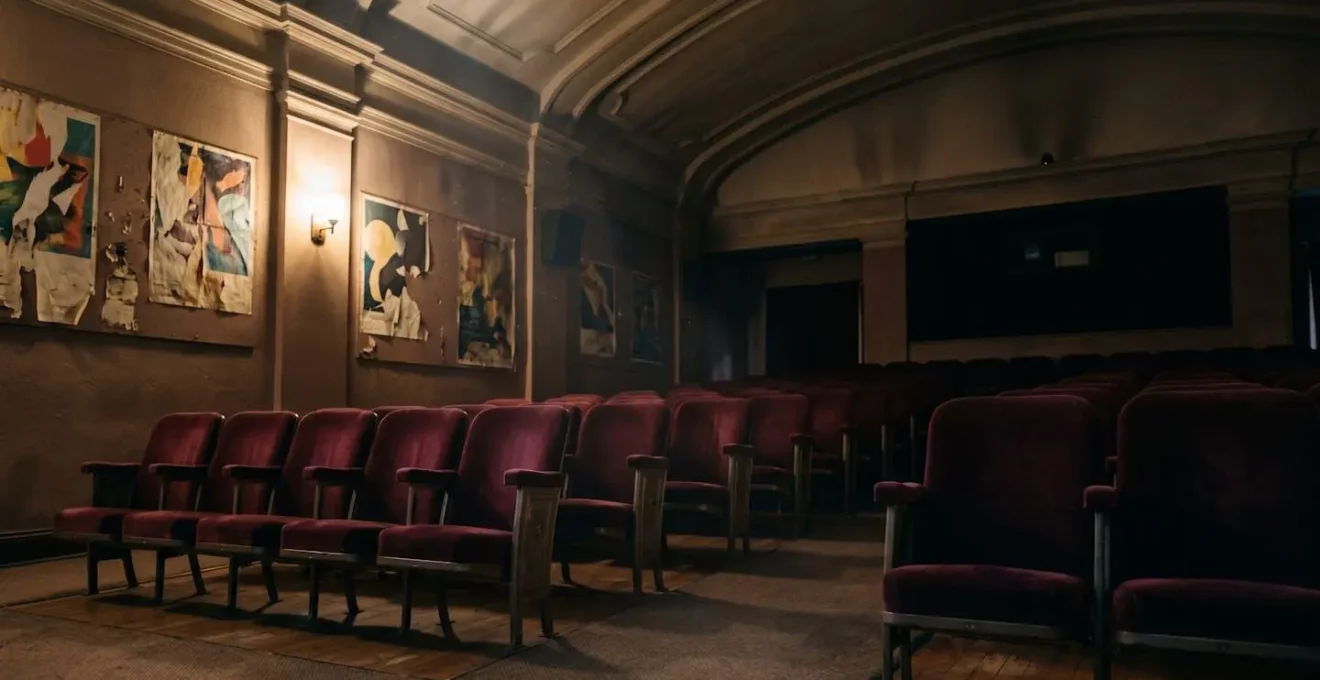
Contrary to popular belief, finding transformative films isn’t about luck or having ‘good taste’; it’s about mastering a deliberate craft of cinematic discovery.
- The most commercially successful films are often engineered for broad appeal, which inherently limits their emotional complexity and depth.
- Streaming algorithms create feedback loops that trap you with familiar content, actively hiding the very masterpieces you seek.
Recommendation: To find films that truly resonate, you must abandon passive viewing and adopt the proactive mindset of a curator—seeking out human-led sources, creating the right viewing environment, and embracing challenging narratives.
There’s a specific, gnawing dissatisfaction that every thoughtful film lover knows. You settle onto the sofa, scroll through an endless digital sea of thumbnails, and land on the week’s biggest blockbuster. Two hours later, the credits roll, and you feel… nothing. It was loud, visually impressive, and perfectly paced, yet it left no emotional trace. This experience isn’t a failure of the film, which likely achieved its commercial goals, but a sign that your appetite for storytelling has evolved beyond the mainstream menu. You’re no longer seeking simple entertainment; you’re hunting for emotional resonance, for films that challenge, reshape, or affirm your view of the world.
The common advice—check review aggregators, follow the Oscars, or trust the « Because You Watched » suggestions—often leads back to the same formulaic territory. These systems are designed to validate popularity, not to unearth profundity. The truth is that a universe of deeply moving, artistically audacious cinema exists, but it operates on a different frequency, hidden from the loud static of blockbuster marketing and algorithmic bias. The key to accessing it isn’t about finding a secret list or a magic password.
The shift required is from being a passive consumer to an active curator. It involves understanding the commercial and technological forces that shape what you see, and then consciously choosing to step outside of them. This guide is not a list of movies to watch. It is a map and a compass, designed to equip you with the strategy and mindset to navigate the vast cinematic landscape and discover the films that will stay with you long after the screen goes dark. We will explore why the biggest films often feel the emptiest, how to find masterpieces before they become famous, and why the culture of distraction is the greatest barrier to profound cinematic experiences.
This article provides a complete framework for transforming your relationship with cinema. Below, you will find a detailed exploration of the methods and mindsets required to become your own best film curator.
Summary: A Curator’s Guide to Finding Emotionally Resonant Cinema
- Why Do the Highest-Grossing Films Rarely Deliver the Deepest Emotional Impact?
- How to Find Hidden Masterpiece Films Before They Win Major Awards?
- Slow Cinema vs Plot-Driven Films: Which Creates Deeper Emotional Connection?
- The Streaming Algorithm Trap That Prevents You Discovering Great Cinema
- When Should You Watch Challenging Films to Fully Appreciate Their Impact?
- Why Can You No Longer Finish Books You Would Have Devoured 10 Years Ago?
- Why Do Some Holidays Remain Vivid for Decades While Others Disappear?
- How Can You Find Books That Completely Absorb You in Today’s Distraction Culture?
Why Do the Highest-Grossing Films Rarely Deliver the Deepest Emotional Impact?
The feeling of emptiness after watching a major blockbuster is not a coincidence; it’s a feature of their design. Highest-grossing films are financial assets engineered to appeal to the broadest possible global audience. This requires them to operate on a set of universally understood, and therefore simplified, emotional trajectories. To minimize risk and maximize returns, they rely on narrative formulas that have been proven to work, sanding down any complex, ambiguous, or culturally specific edges that might alienate a segment of the market.
The result is a phenomenon of emotional homogenisation. A detailed study of over 6,000 films revealed that the most commercially successful narratives, like the « Man in a Hole » (a character gets into trouble and gets out of it) or « Cinderella » (a rise in fortune) arcs, dominate the box office. These patterns provide a comforting, predictable catharsis but rarely challenge the viewer or leave a lasting, complex emotional imprint. They are designed for consumption, not contemplation.
Furthermore, research into the emotional content of movies confirms this. An extensive analysis of film scripts showed that the most popular movies often exhibit startlingly low levels of nuanced emotions. One study found that for the top 30 most popular films, the mean values of less than 0.2 were recorded for happiness and surprise, indicating a reliance on more primal feelings like fear and anger. These films aren’t trying to orchestrate a symphony of human feeling; they are built to hit a few powerful, percussive notes. The pursuit of universal appeal inevitably leads to a dilution of the specific, personal, and often contradictory emotions that define profound art.
This is why the search for moving cinema must begin with a conscious step away from the box office charts, which are not a measure of artistic merit but a ledger of market efficiency.
How to Find Hidden Masterpiece Films Before They Win Major Awards?
If the mainstream is a curated desert, then film festivals are the oases. These events are the primary ecosystems where bold, original, and uncompromised cinematic voices are nurtured and discovered. Before a film wins an Oscar or gets a wide distribution deal, it almost certainly made its mark at a key festival like Sundance, Berlin, Rotterdam, or Locarno. Learning to navigate this world is the single most effective strategy for finding great films years before the mainstream catches on.
The journey of discovery is an art in itself, a rewarding process of connecting dots that lie far outside the Hollywood system. It requires shifting your focus from the finished product (the award-winning film) to the process of curation itself—following the tastemakers who find the talent first.
This path is less about attending festivals in person and more about treating them as curated guides. By monitoring their official selections, you are outsourcing the initial search to teams of experts whose job is to watch thousands of films to find the few that truly matter. This curatorial practice transforms film discovery from a passive act of consumption into an engaging, proactive pursuit of art.
Your Action Plan: Unearthing Cinematic Gems
- Track Feeder Festivals: Monitor official selections at Sundance (which often showcases future indie hits), Rotterdam’s Panorama, Locarno’s experimental programs, and Berlin’s Forum section. These are the primary launchpads for visionary work.
- Follow the Programmers: Identify and follow key festival programmers on social media (like Letterboxd or Twitter). Their personal recommendations and early praise are invaluable signals, pointing to talent years before mainstream recognition.
- Monitor Prestigious Funds: Track the grant recipients of organizations like the Sundance Institute Labs, CNC’s Aide aux cinémas du monde, and the Hubert Bals Fund. These bodies identify and fund visionary filmmakers 2-3 years before their films even premiere.
- Use ‘Adjacent Discovery’ on Letterboxd: Find a niche film you love on Letterboxd. Explore the user-created thematic lists it appears on. Follow the reviewers on those lists who share your taste and examine their entire rating history to build a human-curated discovery path.
- Attend Non-Competitive Festivals: Pay attention to curated, non-competitive events like the Telluride Film Festival. They often reveal their lineup on opening day, creating surprise discoveries that become major award contenders months later.
By adopting these methods, you are no longer waiting for a great film to find you; you are actively participating in the ecosystem that champions it.
Slow Cinema vs Plot-Driven Films: Which Creates Deeper Emotional Connection?
In our quest for emotionally resonant films, we often encounter a challenging genre: « slow cinema. » These are films characterised by long takes, minimal dialogue, and an emphasis on atmosphere over action. The common complaint is that they are « boring » or « nothing happens. » This perspective, however, misunderstands their purpose. Slow cinema is not a failed attempt at plot-driven narrative; it is a different mode of storytelling altogether, one that can create a uniquely profound emotional connection if the viewer is willing to adjust their expectations.
Plot-driven films, like the blockbusters discussed earlier, are designed to engage our analytical minds. We track clues, anticipate twists, and process information. Slow cinema, by contrast, aims to disarm this analytical part of the brain. Its deliberate pacing, focus on texture, and observational style invite a more meditative and sensory engagement. It asks us not to think about what will happen next, but to feel what is happening *now*. This requires a different kind of attention—not the tense focus of a problem-solver, but the open, receptive awareness of a meditator.
This isn’t just a philosophical idea; it has a basis in neuroscience. Recent studies have shown that viewers watching slow films exhibit heightened activity in brain regions linked to sustained attention and emotional regulation. Unlike the short dopamine bursts provided by fast-paced action sequences, slow cinema fosters a state of mind where more subtle, complex emotions can surface and be processed. It gives the viewer the time and mental space to connect the images on screen to their own memories, feelings, and experiences. As one research paper noted, this style of film helps the viewer « re-examine the self and the surrounding world, and rebuild the emotional connection. »
The emotional impact of slow cinema is not delivered; it is co-created in the space between the screen and the viewer. It’s an investment of attention that pays dividends in emotional depth, offering a powerful antidote to the fleeting thrills of conventional storytelling.
The Streaming Algorithm Trap That Prevents You Discovering Great Cinema
In theory, streaming services should be a golden age for film discovery. With vast libraries at our fingertips, the potential to stumble upon a hidden gem has never been greater. Yet, the reality is often the opposite. As IndieWire critic David Ehrlich famously put it:
Movies have never been more accessible, and they’ve never been harder to find.
– David Ehrlich, IndieWire
The culprit is the very tool designed to help us: the recommendation algorithm. These systems are not programmed to help you find the *best* film or the most *artistically significant* film. They are programmed with one overriding goal: to keep you watching, to minimize the time you spend searching, and to reduce the risk of you clicking away. To do this, they create a personalised feedback loop, recommending content that is statistically similar to what you’ve already watched. This creates an « algorithmic ghetto »—a comfortable, predictable bubble that systematically excludes anything too different, challenging, or niche.
This isn’t a hypothetical problem; it actively buries world-class cinema. A critically acclaimed film might be technically « available » on a platform but remain functionally invisible if it doesn’t fit the algorithmic model.
Case Study: The Invisible Masterpiece
Chung Mong-hong’s ‘A Sun,’ a Taiwanese crime epic that won the most prestigious film awards in its home country and garnered rave reviews at the Toronto International Film Festival, was released worldwide on Netflix. Despite its immense critical success, it was never promoted by the platform’s algorithm. For most users, it never appeared on a home screen or in a recommendation row. The film existed in the library, but without active, non-algorithmic searching, it was almost impossible to find. This exemplifies how streaming platforms can acquire cultural prestige by hosting acclaimed international cinema while simultaneously burying it, preventing it from ever reaching the audience it deserves.
To escape this trap, you must recognise the algorithm for what it is: a tool of commercial efficiency, not a guide for cultural discovery. True discovery requires a deliberate rejection of its suggestions, pushing you to use the platform as a simple database to be searched with intent, guided by the external, human-led curatorial sources discussed earlier.
You must become the curator the algorithm will never be. Your watchlist should be built from festival lists, critic recommendations, and film journals—not from a row of thumbnails generated to predict your next click.
When Should You Watch Challenging Films to Fully Appreciate Their Impact?
Finding a challenging, potentially transformative film is only half the battle. To fully absorb its impact, you must also cultivate the right viewing conditions. We often treat all screen time as equal, watching a Tarkovsky masterpiece with the same divided attention we give to a sitcom while scrolling through our phones. This is the primary reason why challenging films can feel « difficult » or « boring »—we are not giving them the cognitive and emotional space they require to work their magic.
Appreciating complex art is not a passive activity; it demands a degree of mental and emotional presence. Treating a film viewing like a significant event, rather than a casual distraction, is crucial. This means consciously shifting your mindset from passive consumption to active engagement. The following practices are not just suggestions; they are essential rituals for any cinephile serious about experiencing the full power of the medium.
Adopting these viewing rituals can dramatically alter your experience with challenging cinema:
- Apply Cognitive Load Principles: Your brain has a finite capacity for sustained attention. Schedule films that require high cognitive load (like experimental narratives or slow cinema) for periods when your mental energy is at its peak, such as a weekend morning, rather than late at night when you are fatigued.
- Practice ‘Appointment Viewing’: Treat the film like a theatre performance. Set a specific time, eliminate all digital distractions (put the phone in another room), dim the lights, and commit your full, undivided attention. This ritual signals to your brain that this is an important event.
- Implement Pre-Viewing ‘Priming’: Prepare your mind for the film’s specific tone. Before a meditative or atmospheric film, spend 10-15 minutes listening to ambient music. Before a politically charged documentary, read a brief contextual article. This priming helps you meet the film on its own terms.
- Allow for Processing Time: The impact of a great film often solidifies in the moments *after* it ends. Schedule at least 20-30 minutes of unstructured time post-viewing. Go for a walk, listen to the soundtrack, or simply sit in silence. This deceleration allows the emotional and psychological connections to deepen.
By curating not just *what* you watch, but *how* you watch, you create the necessary conditions for a film to move from being simple content to a truly transformative experience.
Why Can You No Longer Finish Books You Would Have Devoured 10 Years Ago?
This question might seem out of place in a discussion about cinema, but it strikes at the heart of the same cultural malaise. The frustration of finding your attention drift from a novel you know you should be loving is a direct symptom of the same « attention crisis » that makes challenging cinema feel impenetrable. Our modern media environment, dominated by fast cuts, infinite scrolls, and notification pings, has rewired our brains for a different kind of consumption.
Think of your attention as a muscle. Ten years ago, without the constant barrage of digital stimuli, that muscle was regularly exercised through deep, sustained engagement with singular tasks, like reading a book for hours. Today, that muscle has been retrained for rapid context-switching. We are rewarded with tiny dopamine hits for checking an email, glancing at a headline, or watching a 15-second video. Our brains have become incredibly efficient at shallow, wide-ranging scanning, but this has come at the cost of our ability for deep, linear focus.
A blockbuster film, with its rapid editing (average shot lengths are often under 3 seconds) and constant narrative propulsion, caters perfectly to this neurologically rewired state. It doesn’t require a strong attention muscle; it constantly re-engages you with new stimuli. A slow film, or a dense novel, does the opposite. It demands that you bring your own focus to the table. When you find yourself unable to do so, it’s not a personal failing; it’s a sign that your cognitive endurance has been conditioned for sprints, not marathons. The impatience you feel with a long, descriptive paragraph in a book is the very same impatience that arises during a three-minute unbroken take in a film.
Recognising this connection is liberating. The struggle to engage with deep art is not a reflection of the art’s quality or your own intelligence, but a reflection of the distracting world we inhabit. Rebuilding that attention muscle—through practices like appointment viewing and digital detoxes—is a revolutionary act that benefits not just your cinematic life, but your entire intellectual world.
Why Do Some Holidays Remain Vivid for Decades While Others Disappear?
Consider two holidays. One was a meticulously planned, whirlwind tour of a famous city: seven museums, four famous landmarks, and three recommended restaurants in 72 hours. The other was a week spent in a quiet coastal town with no itinerary, where the most significant events were a long, meandering conversation with a local fisherman and the discovery of a hidden cove. Which one do you think remains a sharp, emotionally charged memory twenty years later?
Almost invariably, it’s the second one. This phenomenon reveals a profound truth about how we form lasting memories, a truth that applies as much to our lives as it does to the films we watch. The most memorable experiences are rarely the ones with the most packed « plot » or the most impressive « set pieces. » Instead, they are the ones that provide space for unexpected emotional resonance. The holiday itinerary, like a blockbuster’s plot, is a sequence of events. The quiet week, like a great art film, is a container for experiences.
Psychologists refer to concepts like the « peak-end rule, » which suggests we remember experiences based on the emotional peak (the most intense point) and the end, rather than the sum total of every moment. A blockbuster delivers a series of manufactured, high-intensity peaks—explosions, dramatic reveals—but because they are formulaic, they rarely create a unique or personal emotional high. They are forgettable because they are interchangeable. The conversation with the fisherman, however, was an authentic, unscripted moment of human connection. It was an emotional peak unique to you, and therefore, it became an anchor for the entire memory of the trip.
When we seek out films that move us, we are not looking for a checklist of narrative events. We are searching for those singular, authentic moments—a glance, a line of dialogue, a sustained shot of a landscape—that can create a personal emotional peak and anchor a film in our memory forever.
Key Takeaways
- True cinematic discovery is an active skill, a ‘curatorial practice’ that requires moving beyond passive, algorithm-led consumption.
- The emotional depth of a film is often inversely proportional to its box office success, as commercial formulas flatten nuance to achieve broad appeal.
- Our ability to appreciate challenging art is directly linked to our ‘attention muscle’, which has been weakened by modern digital culture but can be retrained.
How Can You Find Books That Completely Absorb You in Today’s Distraction Culture?
To bring our exploration full circle, let’s return to the question of finding absorbing books. The answer is now clear: you find them using the exact same methodology you would use to find a great film. The principles of meaningful discovery are universal, transcending medium. This is the ultimate synthesis of the curator’s craft.
First, you reject the algorithm. Just as you would ignore Netflix’s « Top 10, » you must look beyond Amazon’s best-seller lists and Goodreads’ most popular recommendations. These are metrics of commerce and popularity, not indicators of depth or originality. They will lead you to the literary equivalent of a blockbuster—competent, entertaining, but rarely transformative.
Second, you seek human curation. Instead of algorithms, you follow the people. Find a literary journal that champions new voices (like *The Paris Review* or *Granta*). Identify a small, independent publisher known for its distinct taste. Follow critics whose long-form reviews demonstrate a sensibility that aligns with your own. Follow your favourite authors and see who *they* are reading and recommending. You are building a web of trust based on shared human taste, not a feedback loop based on data points.
Finally, you curate your environment and your attention. You practice the literary equivalent of « appointment viewing. » You set aside dedicated, phone-free time to read. You allow yourself to sink into the world of the book without the expectation of constant plot progression. You give the author the same respect you would give a director, trusting them to guide your experience. You are rebuilding your attention muscle, one page at a time.
This is the ultimate secret. The craft of finding a film that will change your life is the same craft that will lead you to a book that will absorb you for days. It is the art of mindful consumption in a mindless world, and it is a skill that, once learned, will enrich every aspect of your cultural life.